You have decided to write a novel, and the internet has answered at every altitude except the useful one. From orbit: believe in yourself, write every day. From two inches: seventeen dialogue tips, a video about em-dashes. In between sits an asteroid belt of plot templates (three acts, seven points, twelve stages) each presented as the load-bearing secret, none explaining what the job as a whole actually consists of.
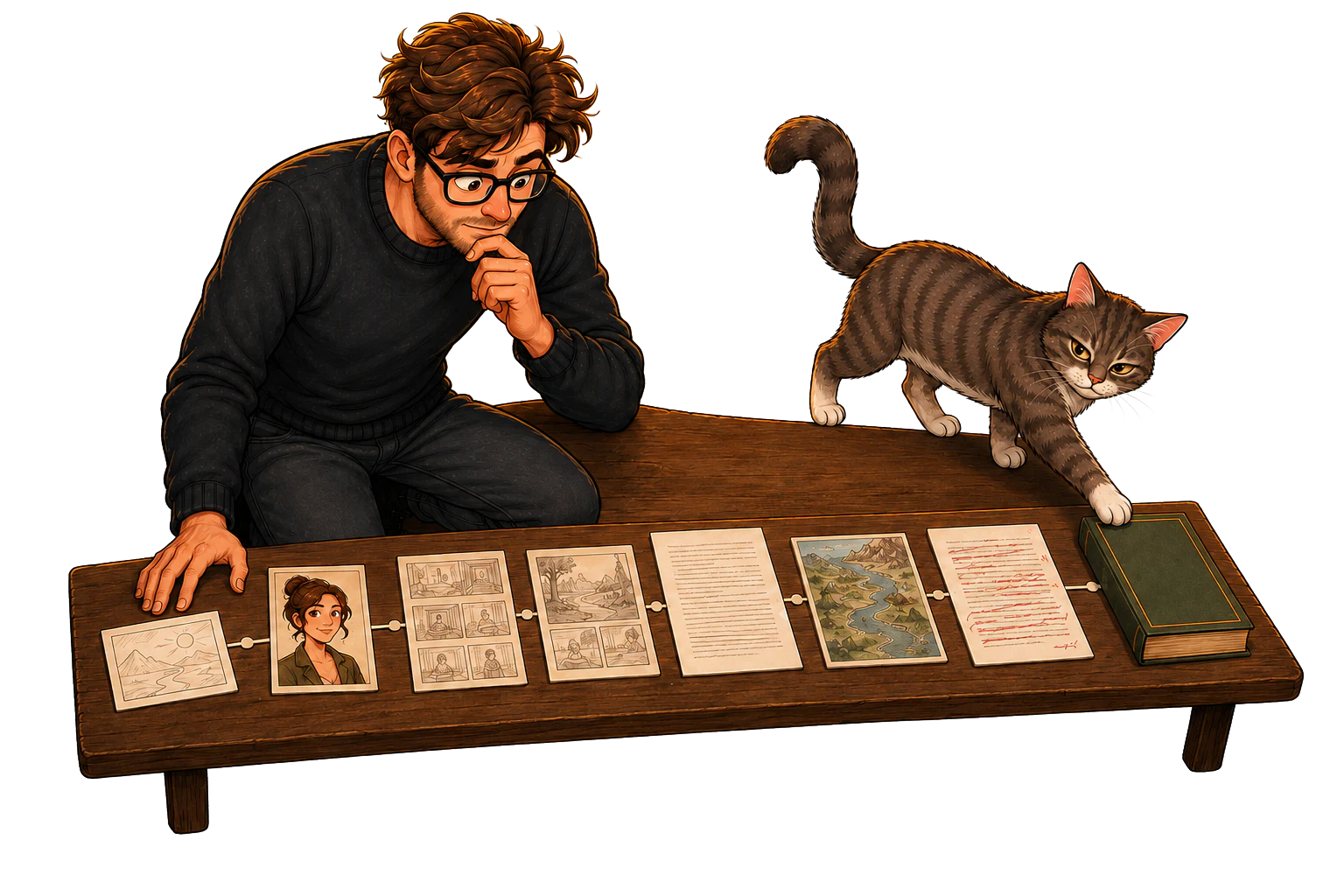
Here is the missing description. A novel is a long sequence of decisions of about seven kinds: the shape of the whole, the people in it, the scenes they collide in, the sentences those scenes are made of, the world that has to stay consistent behind them, the revision that turns a finished draft into a finished book, and the unglamorous practical layer of files and tools underneath everything. This article walks those seven in order and compresses each to its central claim. Every stage has a full guide behind it; this is the map, and the links are the territory.
One honesty clause before the walk. The order below is not a calendar: nobody completes stage one and proceeds. It is the order in which the questions become answerable: you cannot diagnose your middle before a middle exists, and you cannot usefully revise sentences whose scene is going to be cut. You will loop through all of it, repeatedly. What the order buys you is knowing which question you are currently allowed to skip.
“A whole is that which has a beginning, a middle, and an end.”
Shape: a novel is a promise, kept expensively
Strip every structure template down and the same engine is underneath: a promise, progress on it, and a payoff that honours it. E. M. Forster's old distinction still cuts cleanest: the king died and then the queen died is a story; the king died, and then the queen died of grief, is a plot. The difference is causation, and causation is what your reader is actually reading for.
The promise is made in the opening, whether you meant to make one or not: your first chapter puts a question in the reader's head, and everything afterwards is measured against it. What that contract consists of, and why professional readers stop on page one, is the first structural guide worth reading: before drafting, because it is cheaper to promise the right book than to rewrite towards it. The middle is where the promise goes to die: not through bad chapters but through decent chapters that all do the same job, which is invisible from inside any one of them. The diagnostic for that (one line per chapter, what changed, who caused it) is the sagging-middle guide, and you will want it around chapter fourteen. And pacing, the note every writer eventually receives, is not speed; it is the rate of change per page, which is why a car chase can drag and a conversation can fly.
People: a want, a need, and the lie between them
Plot and character are the same decisions viewed from opposite sides. A protagonist who wants nothing generates no causation: nothing for the middle to complicate, nothing for the end to price. The working model is three-layered: what the character wants, what they actually need, and the lie they believe that keeps the two apart. The distance between want and need is where the book lives, and the chapters where that distance visibly changes are your turning points. Anchoring those turns to specific chapters (so the arc is a checkable thing rather than a vibe) is the character-arc guide's whole method.
Scenes: the unit the draft is actually made of
You do not write a novel. You write two hundred scenes, and the novel is what they add up to, which makes the scene the most consequential craft unit you own, and the most commonly untaught. The test that sorts working scenes from stalled ones is a single question: what became impossible during these four pages that was possible before them? A scene turns or it stalls, and planning the turn beat by beat is the difference between drafting towards something and typing. When you sit down each day, this is the altitude to sit down at: not "a thousand words", but "the scene where she finds the ledger".
Sentences: who is speaking, and from how close
Three sentence-level decisions do most of the work that gets called voice. The first is point of view and psychic distance: not the marketing question of first versus third, but how close the narration stands to the character's skull, and how deliberately you move that camera. The second is dialogue, where the craft is almost entirely in what is not said: people speak to get things, rarely to inform, and a conversation where everyone says what they mean is a scene with no floor under it. The third is exposition (how the reader learns what they need without the story stopping to teach) and it is the discipline your world section is about to make harder.
World: record commitments, not inventions
Every novel has continuity (a timeline, relative ages, who knows what by chapter twelve) and it breaks about as often in a book set over one summer in one town as in an epic. The instrument is a story bible, and the method matters more than the tool: start it during the draft rather than before, record what the pages have committed to rather than what you have invented, and treat revision as the danger point, because a cut scene silently un-establishes everything only it established. If your book is fantasy or science fiction the same method runs hotter (there is no real world to check against, so every drafted sentence becomes canon) and the fantasy-specific version is its own guide, covering the economy of wonder and magic that can say no.
Revision: converge, don't orbit
A finished first draft is not a rough version of the book. It is the material the book gets made from, and the difference between revising and re-typing is whether each pass has an intention it can finish. The failure mode is orbiting (reading from page one, polishing sentences until the will runs out around chapter six, repeat) which improves the first quarter of a manuscript five times and the last quarter never. The working alternative is passes with named intentions and protected checkpoints: one problem per pass, the draft as it stood preserved before each, so cutting becomes reversible and therefore possible. Expect the middle to lose the most; that is normal, and the sagging-middle diagnostic above will have told you where.
The working life: files, tools and the boring victories
None of this is craft, and all of it has ended more manuscripts than bad dialogue ever has. Somewhere before chapter ten, decide where your manuscript actually lives and what backs it up: the writers who lose books are almost never the ones who decided. If you are choosing software, choose it once, deliberately, with a criteria list rather than a shopping spree, pick the planning views that match how your head works, and then stop evaluating tools, because switching apps is the most respectable-looking procrastination a writer owns. (If you are moving an existing project, the migration is a solved problem.) Two decisions can wait until the end: formatting the finished book for submission, print or EPUB, which is a weekend once the manuscript deserves it, and where you stand on AI, which is worth deciding before the tools decide for you: the authorship line between software that answers questions about your book and software that writes it is the one that matters.
A novel is not written in the order it is read. It is written in the order its questions become answerable.
The whole job, on one page
- Promise: one sentence, phrased as the question chapter one puts in a reader's head.
- Person: a want, a need, and the lie keeping them apart.
- Scenes: draft at the scene level; every scene changes something or gets cut later.
- Sentences: choose the camera distance on purpose; let dialogue want things; feed the reader, don't lecture them.
- World: a bible of commitments, started at chapter three, updated at the moment of the lookup.
- Middle: around chapter fourteen, run the change-column diagnostic before adding anything.
- Revision: named passes, protected checkpoints, the middle loses weight.
- Files: know where the manuscript lives and when it was last backed up, from week one.
Plans first
Promise, person and a scene list before drafting; the bible grows from the outline; the middle diagnostic runs on the plan, cheaply, before the chapters exist.
Pays for it in revision of a different kind: the draft discovers what the outline could not, and the plan must be renegotiated, not obeyed.
Discovers by drafting
Drafts to find out; the promise is often discovered around chapter five: at which point the opening is rewritten to match the book that showed up.
Pays for it in structure: the change-column diagnostic and a harder revision, because the first draft was the outline.
Neither column is the correct one; both visit every station, in different orders, and most working novelists are a blend that shifts by book. Which is the last thing worth saying about the whole job: the order above is a map of the decisions, not a test of virtue. The book does not care whether you planned it or surprised yourself into it. It cares whether the promise was kept, the person changed, the scenes turned, the world held, and somebody had the nerve to cut chapter seventeen. Start with the exercise. The rest of the library is here when each question arrives.
Sources and further reading
- 01Aristotle, Poetics (c. 335 BC, S. H. Butcher translation): the whole as beginning, middle and end: the oldest statement of the shape
- 02E. M. Forster, Aspects of the Novel (1927): story versus plot: the king, the queen, and the difference grief makes
- 03Brandon Sanderson, BYU lectures (2020–2025): promise, progress and payoff as the engine underneath every structure template
- 04Ursula K. Le Guin, Steering the Craft (1998): the sentence as the unit of narrative, and the camera work behind point of view
- 05Stephen King, On Writing (2000): second draft equals first draft minus ten per cent, and where the surplus actually sits
Common questions
- How long does it take to write a novel?
- For a first novel, one to four years is the honest range, and the variance is mostly life rather than talent. A steadier measure than time is scenes: a novel is roughly one to two hundred of them, and a writer who finishes two scenes a week finishes a draft inside a year. Deadlines at the scene level survive contact with a job and a family far better than word counts do.
- How long should a novel be?
- The ranges agents and publishers actually work with: most adult fiction lands between 70,000 and 100,000 words; fantasy and historical run longer, up to around 120,000 for a debut; anything under 50,000 is a novella to the trade regardless of what it is to you. First drafts are allowed to miss these numbers freely: the range is a target for the revised book, and middles usually shrink towards it.
- Should I outline my novel or discovery-write it?
- Both methods visit every decision a novel requires (promise, character, scenes, structure) just in a different order, and each pays a known price: planners renegotiate the outline once the draft starts discovering things, discovery writers buy their outline by writing it as a first draft and revising harder. Pick by temperament, expect to drift towards a blend, and distrust anyone selling either as the method.
- What should I write first?
- Any scene you can already see: not necessarily chapter one. Openings carry the most pressure and are the most likely pages to be rewritten once the book reveals itself, so they are an expensive place to learn. One vivid scene teaches you the voice, the person and the turn, and momentum survives on visible progress.
- Do I need special software to write a novel?
- No: novels predate electricity, and a plain document plus a notebook has finished plenty. What dedicated software actually buys is lower friction on the non-typing jobs: keeping structure visible, keeping the continuity record beside the draft, and knowing where the manuscript lives and what backs it up. Decide once, deliberately, and then stop evaluating tools: switching apps mid-book is procrastination in its most respectable outfit.