Chapter twenty-two. Your protagonist's sister comes through the door and you stop, because you can't remember whether she is older or younger. Not in your head: in the book. You have a strong suspicion you settled it around chapter nine, inside a line of dialogue you were rather pleased with, and you now spend nineteen minutes searching the manuscript for the word "sister" and reading straight past it twice.
The maddening part is that you have a story bible. Sixty pages of it. There is a character sheet for the sister. It tells you that her name means dawn in the old tongue, that she is a Capricorn, and that her defining childhood memory involves a kite. It does not tell you how old she is relative to the person whose book this is.
That is not a worldbuilding failure. You know your world; you have never once forgotten what it is like in there. It is a bookkeeping failure, and it is the failure every long project runs into eventually, because the thing that actually breaks across four hundred pages is not your imagination. It is your memory of your own commitments.
You are not trying to remember your world. You are trying to remember what you said
Go and look at the last ten things you interrupted your own drafting to check. I would bet money on the shape of them. What did I call the inn. How far is it between those two towns, because I think I said a day and I need it to be three. Did I already give her the scar, or did I only plan to. What month is it. Did anyone in this room already know about the letter. Does she have the ring in this scene or did she leave it.
Every one of those is the same question in a different coat: what have I already promised the reader? Not what is true of my world in some absolute sense: what is now on the page, in print, unretractable without a rewrite. The value of a record is not that it holds your invention. Your invention is fine. It is that it holds your commitments, in a form you can consult faster than you can search four hundred pages.
A story bible is not a description of your world. It is a ledger of what you have already promised.
This is why the advice to "deepen your worldbuilding" is such a poor answer to the problem. Deepening it makes the ledger longer without making it more consultable. The writer stuck at chapter twenty-two does not need more world. They need to know one small, boring, load-bearing fact, and they need to know it in eight seconds rather than nineteen minutes, because the nineteen minutes is where the afternoon dies.
There is a related question (how much of any of this reaches the reader) and it is a genuinely different craft problem with a different answer, which is handled elsewhere. This article is about the writer's side of the ledger only. What follows would work exactly as well on index cards.
A template asks the questions your book will never ask
Search for a story bible template and you will be handed a form. Forty fields per character, thirty per location, a page for the magic system, a page for the economy. It looks like diligence. It is the single most reliable way to produce a document nobody opens twice.
The mechanism is simple enough. A template is written by somebody who has never read your book, so its fields are the average of all books. Your book is not the average of all books. It will ask, obsessively, about three or four things nobody else's book cares about: in one novel it is who owes money to whom, in another it is who has been told what and when, in a third it is the distance between places and how long the walk takes. And the template does not have a field for any of them, because those are your book's questions and it has never met your book.
So you fill in the fields it does have. You invent a favourite food for a woman who eats nothing on the page. You give a soldier an astrological sign. You do this for eleven characters, feel productive, and then discover at chapter twenty-two that the one thing you needed is the one thing you never wrote down, because filling in a template is a task you complete, whereas keeping a ledger is a habit you maintain, and only one of those survives a first draft.
The template gave you
Full name, age, height, eye colour, hair colour, star sign, favourite food, greatest fear, defining childhood memory, three adjectives.
Nine of those ten never appear in the manuscript and none of them was ever in doubt.
The draft actually asked
Older than Wren by four years: ch. 9, said out loud, can't be moved.
Left the village "the winter of the bad salt", which I have used twice and not dated.
Does not yet know about the letter. Planned reveal ch. 30.
Called Jos by her brother, Josselin by everyone else. Never Joss.
The right-hand column looks scrappy because it is. It is also the one you will consult forty times, because every line of it exists for a reason: at some point in the writing, that specific fact was genuinely unclear and genuinely mattered. Nothing else earns a place.
It is worth knowing that this is how the professionals do it too, and that the professional version starts out looking just as unglamorous. Random House put the question to one of their fiction copy editors (a person whose entire job is catching the errors we are talking about) and her description of the apparatus is not a database.
“When I'm copyediting, I keep an open Word document into which I jot notes about anything I think may be of interest as I keep track of chronology, logistics, plot, and personal details.”
One blank document, filled in the order the manuscript raises questions. The same thing happened at the far end of the scale: the continuity apparatus behind The Wheel of Time (eventually four million words of notes and a published companion volume) began as a file Robert Jordan's editor started while working on the first book, simply to keep track of proper nouns. Nobody sat down in 1989 and designed it. It accreted, one check at a time, in the shape the books demanded.
Half of what you record isn't true yet, and that's the half that matters
Here is the flaw that quietly ruins otherwise decent records, and it is not incompleteness. It is that every line in them is written in the same voice, with the same authority, so that a thing you firmly established in chapter three and a thing you idly thought about on a train sit side by side looking identical. Six months later you cannot tell them apart, and you build chapter thirty on the one from the train.
There are three states a fact can be in, and the record is only useful if it says which.
- Established. It is on the page, in words a reader has read. It cannot be changed without changing the manuscript. Note where: chapter number is enough. This is the only kind of fact that constrains you.
- Intended. You have decided it but not written it. It is real to you and invisible to the reader, which means it is still free. Most of a working bible is this, and that is healthy, but it must be flagged, because intended facts are the ones you misremember as established.
- Contradicted, or superseded. You said one thing in chapter four and another in chapter nineteen, or you changed your mind and the earlier version is still sitting in the draft. This is the most valuable entry in the whole document and the one people delete, because an unresolved contradiction feels like untidiness. It isn't. It is a to-do list for revision that you will otherwise have to rediscover by reading the whole book.
If that sounds like bureaucracy, note that the largest fictional continuity operations in the world are built on this distinction and very little else. Lucasfilm tracked Star Wars continuity in an internal database where the interesting field was never the fact but the tier it sat in, so that when two entries collided the database itself said which one won. It generalises brutally well to a person with a notebook: the status of a fact is worth more than the fact.
The strongest version of this habit is one I would steal outright. Brandon Sanderson's continuity editor keeps the timeline for the Cosmere in a spreadsheet, and each row carries not only the event and the date but the evidence:
“Then I have the quote from the book that I used to justify the timing, the chapter the quote appears in, and whether the event happened on the day of the chapter, or sometime in the past or future.”
The citation travels with the fact. That one move converts a record from a set of assertions (which you will eventually distrust, and rightly) into something you can audit, because every line either points at a chapter or admits that it doesn't. A fact with no citation is not a fact. It is an intention wearing a fact's clothes, and the whole discipline is refusing to let those two things look the same on the page.
Time is the thing you will get wrong
Ask anyone who checks manuscripts for a living what actually goes wrong and they will say chronology before they say anything else. Ages, seasons, durations, how long a journey takes, how long ago the thing that started all this happened. It is the hardest continuity to hold because it is the only one that is relational: a name is either right or wrong on its own, but a date is only wrong in company.
The reassuring assumption is that this is an epic-fantasy problem: that if your novel takes place over one summer in one town you are safe. The copy editor is blunt about it: "chronological issues occur in stories with simple timelines almost as often as they do in stories with complex ones." Her examples are all domestic. Characters having breakfast and then driving from Philadelphia to Boston before lunch. A crucial scene at a government office on what the book's own internal logic has made a Sunday. Overcoats in New York for eleven months of the year. Two full moons a week apart.
Four questions cause nearly all of it, and they are worth writing on something you can see from the desk.
- How old is everyone in this scene? Record birth years or a single reference year, never ages: ages rot the moment you move a chapter, and a record that has to be recalculated is a record that will be wrong.
- How long since the last time we saw these people? The gap between chapters is invisible while you write and glaring when read straight through. One line per chapter is enough: "three days after ch. 14".
- What season is it, and does the book say so? Weather, light, crops and clothing are all promises. A book that goes through two harvests in nine months has told the reader something it did not mean to.
- How long ago is the backstory? This is the one that catches everyone. A woman who "left fifteen years ago" and is thirty-one was sixteen when she left, and if you have also written her as trained, married or grieving beforehand, you have a problem that only arithmetic will find.
The subtlest failure of all is drift between parallel threads, and it is worth understanding because you cannot feel it while drafting. Two viewpoints run alongside each other, you write six chapters of one and five of the other, and the two strands quietly disagree about how much time has passed. Ahlström found exactly this in The Way of Kings: one viewpoint runs fifty days before the other one starts, and two characters who appear to be at the same battle are not, in the arithmetic, in the same week. She also names the reason it could not be cleanly fixed: she was "assigned this job after that book was finished, and as much as we squashed and fudged, there is still a day or two unaccounted for."
That is the real argument for keeping a timeline while you draft rather than reconstructing one afterwards. Reconstruction is archaeology; you are recovering decisions you no longer remember making, from evidence that is now load-bearing prose. Kept as you go, it is a two-line note per chapter. Done at the end, it is a fortnight, and it will still be approximately right rather than right. Tolkien wrote the chronology of The Lord of the Rings alongside the book and then published a version of it as an appendix, but he needed it years before the reader did, and for a different reason.
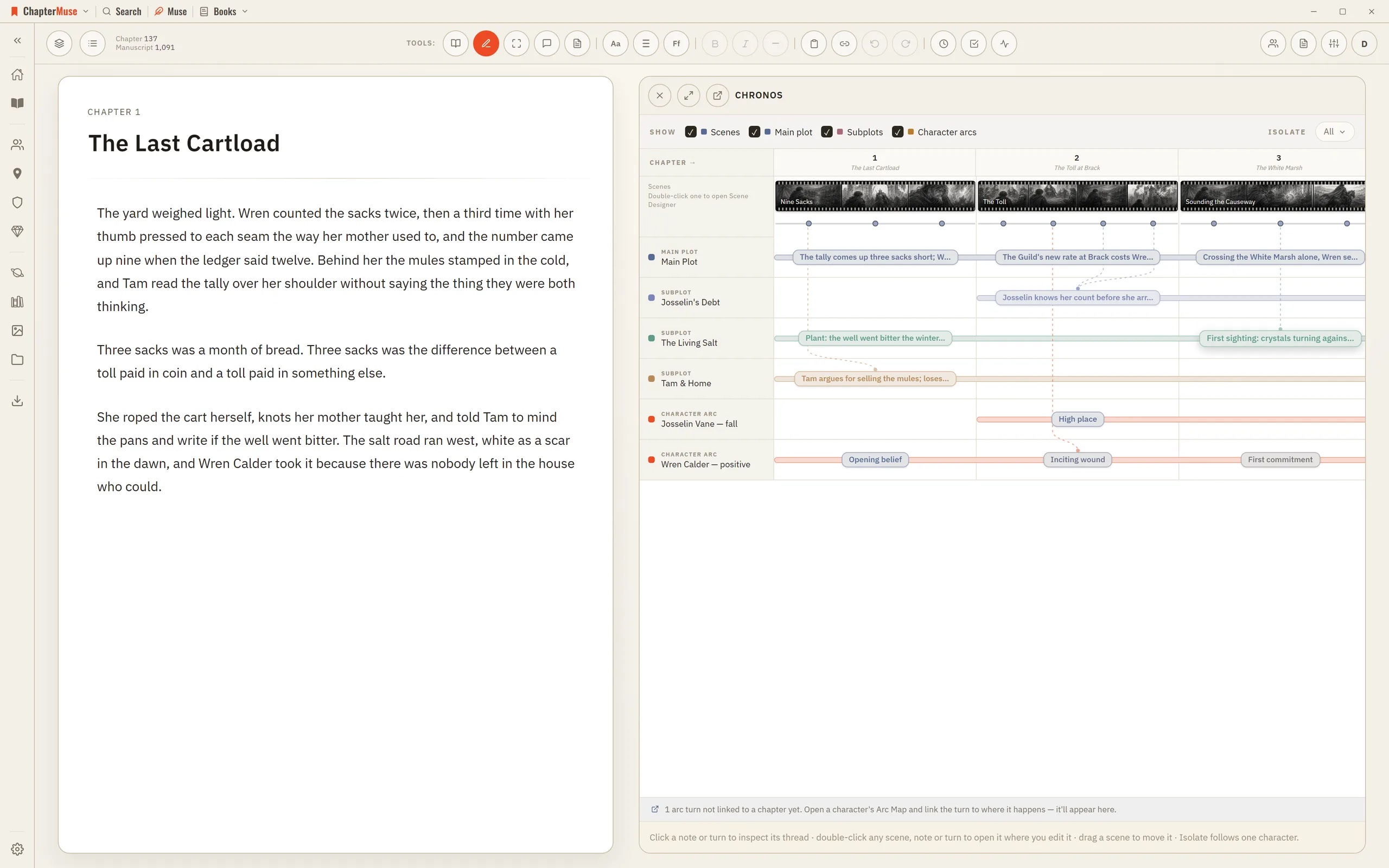
Whether you do that with a wall, a spreadsheet or threads on a shared timeline matters far less than the fact of having one surface where all the strands are measured against the same thing. The error you are hunting is a discrepancy, and discrepancies are only visible in parallel.
A series has two kinds of true, and mixing them is how writers get burned
Once there is a second book, every fact acquires a scope. Some things are true of the world permanently: how the magic costs, how far the capital is, who is dead. Some things are true only within one book: what a character believed in chapter nine, who was in the room, what the weather did. The failure is not forgetting either. It is filing one as the other.
Promote a book-level improvisation to a world rule and you have accidentally legislated. You needed a character to get across the city fast in book one, so you let them; now the world contains fast travel and book three's siege plot doesn't work. Demote a world rule to a book detail and you will contradict it, cheerfully, in book four, because you last thought about it three years ago. This is the whole reason a series-level record needs a first-established-in pointer on every line: without it you cannot tell a law from an accident, and the two look identical in prose.
The classic demonstration is also the funniest, because it happens to a writer nobody would call careless. In 1887 Doyle sends Watson home from Afghanistan with a specific, memorable injury. Three years later he needs him to have a limp.
"There I was struck on the shoulder by a Jezail bullet, which shattered the bone and grazed the subclavian artery."
"I made no remark, however, but sat nursing my wounded leg. I had a Jezail bullet through it some time before, and, though it did not prevent me from walking, it ached wearily at every change of the weather."
Same bullet, same war, different limb, three years apart. And it goes further than a wound: in "The Man with the Twisted Lip", Watson's own wife addresses him across the fireside as James, which would be less remarkable if his name were not John. Doyle had not forgotten his world. He had never written down what he had already said about it, because in 1887 nobody had told him he was starting a series, and that is the position most novelists are in when they make the commitments that will bind them.
It is also why the professional answer, once a world gets big enough, is almost always a second person. Sanderson employs a continuity editor. George R. R. Martin sends manuscripts past two long-standing readers who know Westeros better than he does: one of whom caught a Targaryen dynasty timeline that didn't fit dates already in print. Television institutionalised it decades ago: on a scripted show the bible is maintained by the room, often kept current by a script coordinator whose remit includes continuity, and it exists because writers come and go and the incoming ones have to be able to find out what the show has already decided.
Book five is written by a stranger who happens to have your name and your handwriting.
That is the honest way to think about your own future self, and it is more useful than any organising principle, because it tells you what to write down: the things you would need if you had not been in the room. Whether that shared truth lives in a ring binder or in something that holds several books in one continuity, the boundary is the point: what belongs to this book, and what every later book inherits.
A record is only true if updating it is cheaper than ignoring it
Here is the failure that kills more story bibles than every other cause combined, and it has nothing to do with structure. You build it, it is lovely, and then the draft changes. You cut chapter seven. You move the confrontation from spring to autumn. You rename the sister. And the bible (which is now wrong) says nothing, makes no noise, and quietly becomes a document that will lie to you at the exact moment you finally trust it enough to consult it.
A record you cannot trust is worse than no record, because no record makes you go and check.
So the design goal is not completeness. It is making the update cost almost nothing, and there are only a few moves that genuinely do that.
Update at the moment of the check, never in a session
The instinct is to set aside Sunday afternoon for continuity admin. Nobody has ever done this twice. The version that survives is that the update happens in the same ten seconds as the lookup: you searched for it, you found it, you write the line before you go back to the prose. That is the entire discipline, and it works because the cost is paid at the moment you can already feel the benefit.
Never store anything twice
The single biggest source of stale entries is duplication. If your bible contains a paragraph of the manuscript, you now have two copies of that paragraph and you will only ever revise one. Record the pointer, not the passage: "described ch. 12" rather than a transcription. The prose is the authority; the record is an index to it. Anything you copy out is a maintenance debt you have volunteered for.
Record inputs, not outputs
Store the thing that doesn't change and derive the rest. Birth year, not age. Distance, not travel time. Founding date, not "three hundred years ago". Every derived value you write down is a value that goes wrong silently when you move a chapter, and it goes wrong without ever announcing that it has.
Most of what you know should stay out of it
The last discipline is subtraction, because a bible's usefulness is inversely proportional to how much scrolling stands between you and the answer. Four things do not belong in it.
- Anything a search would find faster. Exact wording, descriptions, who said what: that is what the manuscript is for, and a search across the whole project beats any transcription you could make of it. Record the facts that are distributed across the book, because those are the ones no single search can retrieve: relative ages, elapsed time, who knows what.
- Anything derivable. Covered above, and worth repeating because it is the most tempting kind of entry: it feels like being thorough, and it is actually building a second thing to keep in sync.
- Anything the book will never ask. The star signs. The favourite meals. Not because such details are worthless (they are often where characters come from) but because they are generative material and belong wherever you keep half-formed ideas, not in the document you consult under time pressure. Mixing the two is how the ledger becomes unsearchable.
- Anything you are not prepared to put a status on. A half-remembered guess entered flat, with no tick and no question mark, is the most dangerous line in the document, because you will read it back in nine months in perfect good faith and build on it.
There is one more, harder to state. Do not write the things you are still deciding in the tone of things you have decided. That is how the record stops being a ledger of promises and becomes a second, tidier place to do your imagining, which is pleasant work, and is not the work.
What to do about chapter twenty-two
Don't open a template. Open a blank page and write down the last ten things you had to go and look up in your own book, with the answer and the chapter you found it in, and a question mark next to the two you couldn't confirm. That is a story bible. It took eleven minutes and it is already more useful than the sixty pages, because every line of it was earned by an actual interruption to an actual afternoon.
Then let it grow the only way that works: one entry per check, forever, always at the moment of the check. It will be lopsided. It will have forty lines about money and nothing about the weather, or the reverse, and the lopsidedness is not a defect: it is a fairly precise map of what your particular book demands that you keep straight. No template could have predicted that shape, which is exactly why no template produced a document you would open twice.
And when you find the contradiction (the sister who is older in chapter nine and younger in chapter twenty-two) resist the urge to fix it immediately and lose the afternoon. Mark it, note both chapters, and keep writing. A contradiction you have recorded is a revision task. A contradiction you have merely noticed is something you will have to find again.
Sources and further reading
- 01Milena Schmidt, "Maintaining Continuity: Tales from the Copy Editor", Penguin Random House (2015): a Random House fiction copy editor on her one open Word document, and why simple timelines break as often as complex ones
- 02Karen Ahlström, "Oathbringer's Timeline" (2017): a working continuity editor on citing the evidence for every dated event, and the fifty-day drift between two viewpoints in *The Way of Kings*
- 03Arthur Conan Doyle, A Study in Scarlet (1887): Watson's Jezail bullet, in the shoulder
- 04Arthur Conan Doyle, The Sign of the Four (1890): the same bullet, three years later, in the leg
- 05Arthur Conan Doyle, "The Man with the Twisted Lip" (1891): Mary Watson calls her husband James
- 06Maria Simons, interviewed at Theoryland (2010): how Robert Jordan's in-house glossary and consolidated notes were kept, and what happens when files share names
- 07"Canon (fiction)", Wikipedia: Lucasfilm's tiered continuity database: the status of a fact recorded alongside the fact
- 08Elio M. García Jr. and Linda Antonsson: the outside continuity-checkers on *A Song of Ice and Fire*, including a Targaryen dynasty timeline correction
Common questions
- What is a story bible?
- In practice, a record of what a book or series has already committed to (names, relationships, dates, rules) kept so the writer can check a fact without rereading the manuscript. It is often described as a document about your world, which is misleading: the parts you never forget don't need recording, and the parts that break a draft are usually small and dull.
- Do I need a series bible for a standalone novel?
- You need something, though it may be two pages. Continuity errors are not proportional to world complexity: copy editors report that chronology breaks about as often in a novel set over one summer in one town as in an epic. The trigger isn't scale, it's length plus elapsed time: a book written over eighteen months is written by several different versions of you.
- How detailed should a story bible be?
- As detailed as your lookups demand and no more. A useful test: could you have answered this without the entry, in under a minute? If yes, the entry is costing you maintenance and buying nothing. The entries worth keeping are the ones about facts distributed across many chapters (relative ages, elapsed time, who currently knows what) because those are precisely the ones no single search can retrieve.
- When should I start a story bible: before or during the draft?
- During, and preferably from about chapter three, when the draft starts asking you questions. Starting before means guessing at what the book will need, which is how you end up with forty fields and no answers. Starting after the draft is finished means reconstructing decisions from prose that has already hardened around them, which is slower and only ever approximately right.
- How do I keep a story bible up to date when the draft keeps changing?
- Update at the moment of the lookup rather than in scheduled sessions, never store the same fact twice, and record inputs rather than derived values: birth years, not ages. Then treat revision as the danger point: when a scene is cut, anything established only in that scene has quietly stopped being established, even though the entry still says it is.