Forty-five thousand words. By any honest count you are past halfway, the sentences still come out, and none of the chapters you wrote this month are bad. You read the last eight back and get a feeling you can't name: something like driving across a country you have already crossed once. The fields keep changing. Nothing is getting closer.
So you go looking for help, and everything you find says raise the stakes, or add conflict. Which is not a diagnosis. It is a description of what a working middle has, arrived at by looking at finished novels backwards, and it is roughly as useful as telling somebody with a limp to walk normally. Your chapter fourteen already contains an argument, a chase and a betrayal. Adding a second betrayal will not fix it, and some part of you knows that, which is why you have been rearranging the same four chapters for a fortnight.
The reason you can't find the fault yourself is the interesting part, and it is what this article is actually about.
Every chapter is fine, which is exactly why you can't find it
Open the draft anywhere in the middle and assess what is in front of you. There is a person who wants something. There is somebody stopping them. Somebody says a thing they'll regret. The chapter ends on a line with a bit of a snap to it. By every test you know how to apply, it passes, and it passes because the test you are applying operates at the scale of a chapter, while the fault you are hunting does not exist at the scale of a chapter.
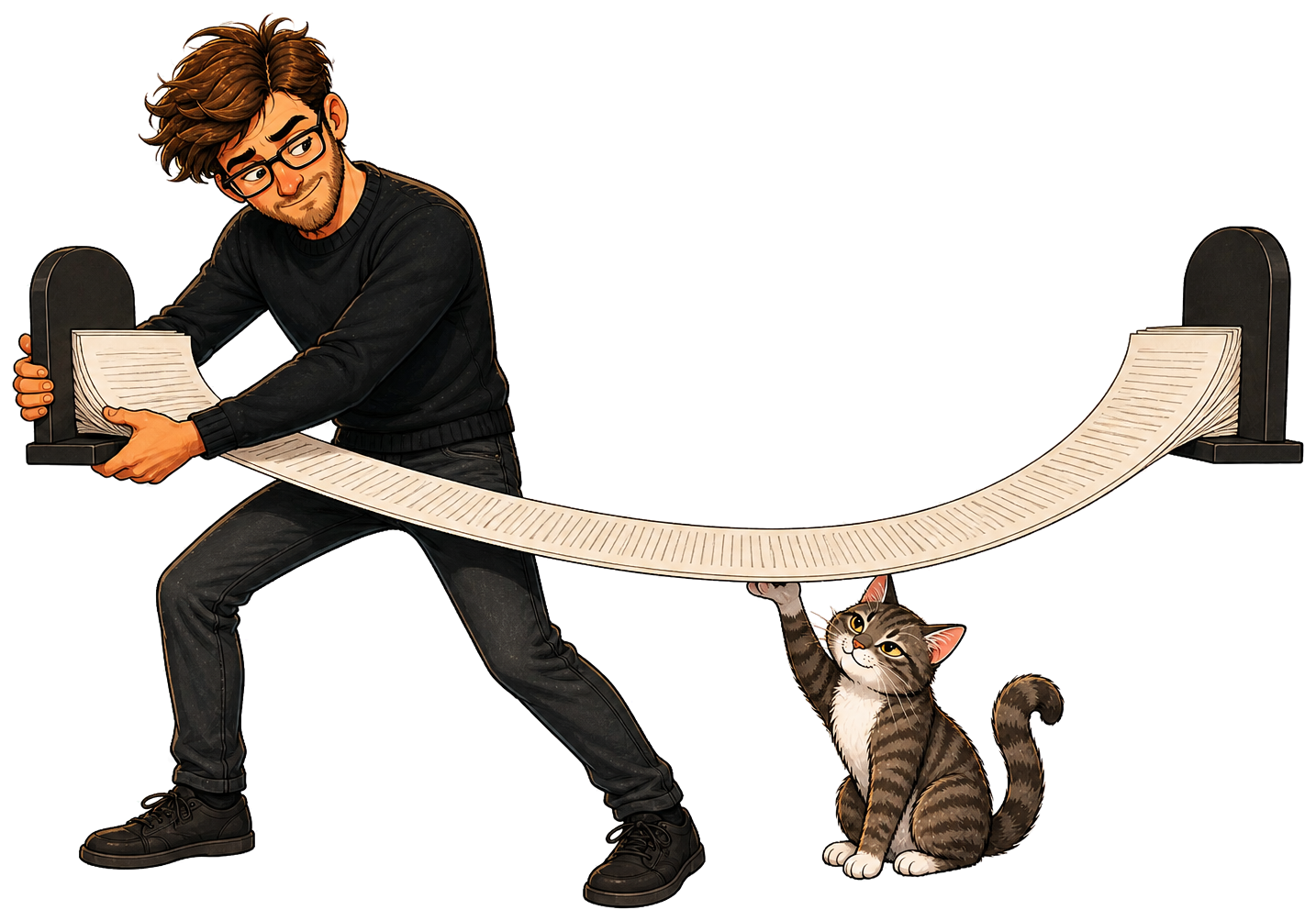
It is a property of the sequence. Hold one square of wallpaper up to the light and there is nothing wrong with it; the pattern only exists once the squares are on the wall next to each other. This is why your reader said it sagged "somewhere in the middle" and couldn't tell you where, and why you were mildly annoyed about that, and why they were right anyway. No chapter is the culprit. That is the whole difficulty.
A sagging middle is rarely a run of bad chapters. It is a run of decent chapters that all do the same job.
Aristotle got there first, and gave the fault a name that is still the most precise one available.
“Of all plots and actions the epeisodic are the worst. I call a plot 'epeisodic' in which the episodes or acts succeed one another without probable or necessary sequence.”
Note what he is not complaining about. Not that the episodes are dull, not that too little happens: his objection is to what sits between them. Episodes that merely succeed one another are interchangeable by definition, and interchangeable material can be extended forever without ever arriving anywhere. Which is exactly the sensation you get reading chapters twelve to twenty-two of your own draft at eleven at night.
The mechanism underneath it is usually simple, and it is not a failure of imagination. In the middle of a book your protagonist typically hasn't decided anything yet. The other side has the initiative; your character is being pushed, and they push back the way that character pushes back, because that is who they are. Same pressure, same response, chapter after chapter. You are varying the content diligently (different rooms, different weather, different supporting cast, a fistfight in one and a funeral in the next) while the function of every chapter stays identical: the protagonist absorbs a blow and resolves to keep going.
That is the sag. Not too little event. Too little variety of event-type. And it is invisible from inside any single chapter, which is why staring harder at chapter sixteen has not worked and will not.
Write down what each chapter changes, then read only that column
Since the fault lives in the sequence, you have to get the sequence in front of your eyes with the prose stripped off. This takes an evening, and it is the most reliable structural diagnostic I know.
- One line per chapter, and the line answers one question only: what is true at the end of this chapter that was not true at the start? Not what happened: what changed. "They travel to the coast and are ambushed" is events. "He can no longer go home" is a change.
- Ban the word "learns" unless the thing learned closes a door. "She learns the ledger was forged" is a fact arriving. "She can't pretend her father was innocent any more" is a change. If most of your lines are facts arriving, that is a finding all by itself.
- Add a second column, two or three words wide: who caused it? The protagonist, another character, or circumstance.
- Add a third: what did it cost, and who paid.
- Now cover the manuscript. Read only the first column, out loud, in order, top to bottom. It will take four minutes.
- Mark every line whose shape matches the line above it. Not the same words: the same shape. "Warned off, presses on." "Warned off, presses on." "Warned off, presses on, this time by his sister."
This is Shawn Coyne's insight in The Story Grid, minus the spreadsheet: he has editors log every scene as a row and then read down the columns rather than across the rows, because the story-level faults only show themselves when you follow one variable across the whole book. You are doing the same thing with a notebook. Reading down the change column is the closest thing to being another person reading your novel that you will ever get.
What surfaces is remarkably consistent by genre, and immediately recognisable once seen. Romance: nearly together, pulled apart, nearly together, pulled apart, with the internal obstacle no deeper on the fourth pass than the first. Mystery and thriller: a lead, a witness, a dead end; a lead, a witness, a dead end. Fantasy: another leg of the road, another skirmish, another camp, everyone slightly more tired. Literary and upmarket: three consecutive chapters in which somebody almost says the thing.
Then read the second column, the one about who caused it. If it says "the antagonist" or "circumstance" fourteen times in a row, you have found the real fault line, and it is not a pacing problem: it is that your protagonist has been a passenger since chapter nine. Nobody wants to be told that at forty-five thousand words, but it is a far more actionable finding than "the middle drags", because it names a thing you can go and change on a specific page.
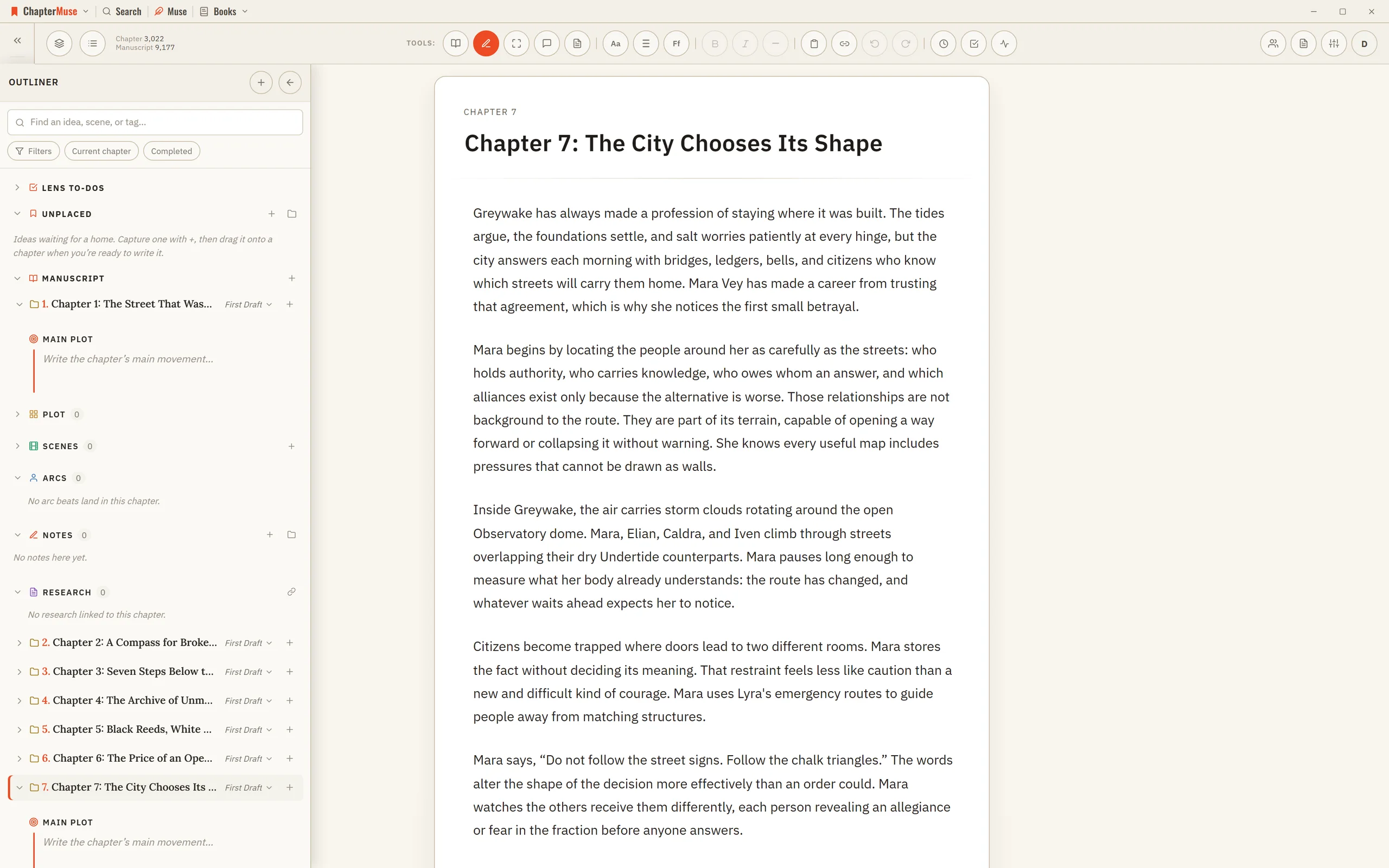
Any surface will do for this: index cards, a notebook, the back of a roll of wallpaper. What matters is that the lines sit next to each other and the prose does not, which is the only real argument for keeping a one-line summary of every chapter somewhere you can read as a block. The scene-level version of the same question (what became impossible in these four pages) is worth running afterwards on whichever chapters the column flagged, and it is a slightly different test.
A complication narrows the field; an obstacle just resets it
So the column has piles in it. The instruction you will be given at this point is escalate, which is another of those words that sounds like advice and functions like a shrug. Escalation is not "make the next one bigger". A bigger version of the same obstacle is still the same obstacle, and readers register size much less keenly than writers think.
Here is the working definition. A complication does at least one of three things: it removes an option the character had, it raises the price of the option they still have, or it makes the next attempt harder than the last one. An obstacle that does none of those is a pause. The character is blocked, then unblocked, and the board is exactly as it was: same pieces, same squares, forty minutes of reading later.
Which gives you a brutally quick test on any two chapters in a pile. Could they swap places without a single line needing to change? If chapter seventeen works perfectly well as chapter twenty-one, they are the same chapter with different furniture, and one of them will have to go or grow. Real escalation is not portable. It cannot be swapped, because the later chapter is only possible on ground the earlier one cleared.
Frankenstein has the cleanest demonstration of this I know, and it is instructive because Mary Shelley spends her middle doing something that ought to sag and doesn't. The creature has been threatening Victor since Geneva, and threats are the classic resettable obstacle: a man is menaced, a man is frightened, a man carries on, and you can run that loop for two hundred pages without the book advancing an inch. Then, in chapter twenty, after Victor has broken his promise and destroyed the half-finished mate, the threat is made one last time.
"Devil, cease; and do not poison the air with these sounds of malice. I have declared my resolution to you, and I am no coward to bend beneath words. Leave me; I am inexorable."
"It is well. I go; but remember, I shall be with you on your wedding night."
Same antagonist, same intention, same room. What has changed is that the threat now has a date on it. Everything vague about Victor's dread becomes a calendar, and the calendar takes his best remaining option (delay) off the table, because the one thing he cannot now do is nothing. It also poisons the only good thing left in the book: every step towards the wedding is a step towards the murder, and Shelley gets to run both at once. That is a complication. It costs her six words and does more structural work than another two hundred pages of menace ever could.
Resettable
The witness refuses to talk. The detective leaves without what she came for.
Everything she could do before the scene she can still do after it. The chapter can be moved anywhere in act two, or cut, and nothing downstream notices.
Narrowing
The witness talks, and is now a witness in the other sense: the only other person who knows, and the reason he'll be dead by Thursday.
She got what she wanted, and getting it removed her ability to walk away. Chapter twenty is now a chapter that could not have been written before this one.
The mechanism has a familiar shorthand: yes-but and no-and. The character succeeds, but the success brings something they can't afford; or they fail, and the ground goes with them. Brandon Sanderson teaches this as the engine of the entire middle rather than a trick for individual scenes, and makes the point most craft books bury: that the escalation matters more than the structure you pour it into.
The midpoint is a change of grammar, not a slot at fifty per cent
Back up three chapters in Frankenstein, to the moment that makes the wedding-night threat possible at all. Victor has spent the novel running: from the creature, from what he made, from Geneva, into the mountains. Then, on the sea of ice, the creature stops menacing him and starts negotiating.
"You must create a female for me, with whom I can live in the interchange of those sympathies necessary for my being. This you alone can do; and I demand it of you as a right which you must not refuse to concede."
Look at what that does to the sentence structure of the novel. Before it, Victor is the object of everything: he is pursued, he is bereaved, he is accused. After it he is the subject of a verb: he agrees, he travels, he gathers instruments, he takes a hut in Orkney and begins. He is doing the worst thing in the book on purpose. And the reader's question has changed with him, which is the part that actually lifts a middle. It is no longer will he get away from this, which can only be answered once. It is what will doing this cost him, which can be answered a little more expensively in every chapter until the end.
A midpoint is not a big scene at the halfway mark. It is the place your protagonist stops being a direct object.
That is the whole of it, and it is why I would rather you held it as a change of grammar than as a beat. John Yorke describes the midpoint as the point of no return, the place where the truth is glimpsed; the beat-sheet tradition draws a line at fifty per cent and calls what happens there a false victory or a false defeat. Both are describing the same joint from outside. The trouble with the fifty-per-cent version is that it is possible to satisfy without doing anything: you can absolutely write a large, loud, expensive scene at word 45,000 and change nothing about who is driving the book, and a great many sagging middles have exactly that scene sitting proudly in the centre of them.
So the test is not positional. Go through the change column and find the first line whose second column says "the protagonist" and means it, where they did something the plot did not require of them, and the next three chapters are shaped by that decision rather than by the antagonist's next move. If it falls at forty per cent, fine. Sixty, fine. If you cannot find it at all, you have not found a pacing problem; you have found that your book is still, at chapter twenty-two, waiting for its main character to want something enough to do something about it.
There is a second hinge further along, and Jim Butcher's much-shared post on the great swampy middle is the clearest thing written about it. His diagnosis of why writers bog down is that they don't know precisely where the middle is going; his prescription is a landmark to steer at. "Plan a great big freaking event for the end of the middle." That is not the same joint as the reaction-to-action flip (it is the wall at the far end of act two) and having one visible from chapter fourteen changes how you write chapters fourteen to twenty-four, because you finally know what they are building towards.
Subplot is load-bearing or it is upholstery
The standard emergency measure for a slack middle is to introduce something: a new character, a romance, a secondary mystery, a disputed inheritance. Sometimes this works beautifully and sometimes it produces eighty pages nobody can defend, and the difference is not craft or execution. It is whether the new material is holding any weight.
The test takes ten seconds. If this subplot resolved off-page, overnight, in a sentence: would the ending of the main plot change? If the answer is no, you have upholstery. It might be charming upholstery. It is still why chapters eighteen to twenty-two feel like a detour, because they are one.
A load-bearing subplot does one of two structural jobs, and it is worth knowing which one yours is doing. The first is variation: it supplies a different kind of change from the main line, so the column stops repeating. If the A-plot is a run of losses, a B-plot that delivers a real gain is not comic relief, it is what makes the next loss legible: you cannot perceive descent without a floor to measure it from. The second job is better still. A subplot can force a choice. Your protagonist can only be in one place at a time, and a second obligation converts a stretch of reacting into a stretch of deciding, without the antagonist having to do anything at all. That is how a middle gets its agency back without any new plot being invented.
Robert McKee's account in Story is the most useful taxonomy: a subplot can contradict the main plot's controlling idea and produce irony, resonate it and produce variation on a theme, complicate the central plot directly, or exist to open a story whose main engine has to start late. Three of the four are structural. None of them is "give the reader a rest", which is what the filler subplot is quietly trying to do.
One further tell, and it is nearly infallible: a subplot that finishes before act three was filler. Load-bearing threads arrive at the climax carrying something: a person, a debt, a piece of knowledge, a reason the protagonist hesitates for one fatal second. If yours ties itself off neatly at chapter twenty-six and is never mentioned again, it was there to fill time, and you probably knew that while you were writing it. This is far easier to see when the threads are visible as rows running the width of the book than when they exist as memories of what you meant to do with them.
Sometimes the middle is sound and the opening lied
Now the case that fools everybody, good editors included. Occasionally you run the whole diagnostic and the middle comes out clean. The changes are varied, the options genuinely narrow, the protagonist is driving by chapter fifteen, the subplot is load-bearing, and readers still drift off at page 160. When that happens the fault is almost never in the middle. It is that the first fifty pages promised a different book from the one the middle is competently delivering.
Sanderson's framing (promise, progress, payoff) is the practical way to hold this. A reader takes your opening as a contract about what kind of attention the book will reward. If chapter one is a woman finding a body in a lock-up, the reader is now watching for whoever put it there. Should chapters twelve to twenty-five be a thoughtful account of that woman's estrangement from her sister, they may well be the best pages in the manuscript, and the reader will still experience them as the book slowing down, because they are progress on a promise nobody made them.
Diagnose it like this. In one sentence, write the question your first chapter puts in a reader's head: phrased as they would phrase it, not as you would. "Who killed him", not "an interrogation of grief and complicity". Then go through chapters twelve to twenty-five and mark every chapter that visibly works on that question. Visibly is the load-bearing word there: thematic work is invisible to a first-time reader, and the first-time reader is who you are diagnosing for. If half the marks are missing, you have found your sag, and it is not where you were looking for it.
The repair is usually at the front of the book, which is excellent news, because rewriting six thousand words of opening is a weekend and inventing eight chapters of plot is a season. Very often the middle is the book you actually wrote (the one your instincts kept steering towards) and the opening is a fossil of the book you intended in January. Change the promise to match what you went on to deliver. That is not a compromise; it is the most common shape of a good second draft, and it is one of the few real advantages of going back over a draft that is already whole instead of trying to fix a book from inside it.
The likeliest fix is that it is twenty thousand words too long
You have been hoping this article would end with something to add. It might. But hold the possibility that your hundred-and-ten-thousand-word draft is a ninety-thousand-word novel that has not been cut yet, because the middle is where the surplus always accumulates. It is where you were working the book out on the page, and working things out requires false starts, second attempts, and three versions of the same conversation held with different people in different rooms.
Stephen King's formula, taken off a rejection slip he was sent at seventeen and kept above his desk, is that the second draft equals the first draft minus ten per cent. As a rule of thumb it is fine. As a description of what actually happens in the middle of a novel it is far too gentle, because you rarely find the surplus spread evenly at a tenth per page. You find it in piles: the exact piles the change column has just shown you. Four chapters doing one chapter's work.
Which makes the operation much less painful than it sounds. You are not scraping a tenth off every paragraph. You are choosing which of the four does the job best, moving the one irreplaceable line out of each of the other three, and deleting them. What you lose is nothing the reader ever knew they had. What you gain is the thing everyone calls pace, and pace is not the speed of events, it is the rate of change per page. Cutting three chapters that changed nothing raises it without a single new incident being invented.
And take the obvious precaution, because nobody cuts bravely while it feels irreversible. Put the chapters somewhere before they go: a graveyard file, a snapshot, anything that keeps the old version recoverable. Half the reason middles stay bloated is that the writer is negotiating with the ten weeks they spent on those chapters rather than with the book, and that negotiation gets considerably easier once nothing is actually being destroyed.
So: fifteen lines, one per chapter, tonight, before you write another word of chapter twenty-six. What changed, who caused it, what it cost. It takes an evening, and at the end of it you will either be looking at fifteen different shapes (in which case your middle is sound and your problem is somewhere in the first fifty pages) or at a pile of four chapters that are all the same chapter. Which is not a crisis. It is a decision about which one lives, and that is a thing you can act on tomorrow morning with the manuscript open in front of you.
Sources and further reading
- 01Aristotle, Poetics (c. 335 BC, S. H. Butcher translation): the episodic plot: episodes that succeed one another without probable or necessary sequence
- 02Shawn Coyne, The Story Grid (2015): logging every scene as a row and reading down the columns, where sequence-level faults appear
- 03Mary Shelley, Frankenstein (1818; 1831 text): the worked example: the demand on the sea of ice (ch. 17) and the dated threat (ch. 20)
- 04Brandon Sanderson, Writing Lecture #3: Plot Theory (2025): try-fail cycles, yes-but and no-and, and escalation mattering more than the structure holding it
- 05John Yorke, Into the Woods (2013): the midpoint as a point of no return rather than a mark at fifty per cent
- 06Jim Butcher, The Great Swampy Middle (2006): bogging down as not knowing where the middle is going, and the big event at the end of act two
- 07Robert McKee, Story (1997): the four uses of subplot: contradict, resonate, complicate, or set up
- 08Stephen King, On Writing (2000): second draft equals first draft minus ten per cent, and where that surplus actually sits
Common questions
- How do I know if my novel has a sagging middle?
- Write one line per chapter naming what is true at the end that wasn't true at the start, then read only those lines, in order. A sag shows up as consecutive lines with the same shape (warned off and presses on, warned off and presses on) even when the chapters themselves are full of different events. If the lines are all different shapes, the middle is probably sound and the problem lies elsewhere.
- What is the difference between a complication and an obstacle?
- A complication removes an option, raises the price of the option that remains, or makes the next attempt harder. An obstacle that does none of those blocks the character and then unblocks them, leaving the board exactly as it was. The quick test is portability: if chapter seventeen could swap places with chapter twenty-one without a line changing, neither of them complicated anything.
- Does the midpoint have to be exactly halfway?
- No. What matters is the change of grammar: the point where your protagonist stops being the thing acted upon and starts being the one acting, so the reader's question shifts from whether they will get out of this to what doing it will cost them. That can land at forty per cent or at sixty. A large scene at the exact halfway mark that leaves the antagonist still driving the book is not a midpoint, however expensive it was to write.
- Should I add a subplot to fix a slow middle?
- Only if it is load-bearing. Ask whether the ending of your main plot would change if the subplot resolved off-page overnight; if not, you are adding pages rather than structure. The two worth adding are the subplot that supplies a different kind of change from the main line, and the subplot that forces your protagonist to choose between two things they want: the second gives a reactive stretch its agency back without any new plot at all.
- How much should I cut from the middle of my novel?
- It is less usefully measured as a percentage than as piles. The surplus in a middle is not spread evenly; it sits in clusters of chapters doing the same job, so the work is choosing which of those chapters does it best, rescuing one line from each of the others, and deleting them. Twenty thousand words is a common answer for a bloated draft, and it usually comes out of six or seven chapters rather than off every page.