You have now written chapter one four times. The first version dropped the reader straight in, and two of your three readers said they were lost. So you wrote a version that explains (the succession, the war, why the river matters, what the Guild is) and the same readers said, kindly, that they skimmed page three. Now you are on the version where two soldiers on a wall explain the war to each other, both of whom fought in it, and you can feel that this is somehow worse, but every article you have read says put your exposition in dialogue, so here you are at half past eleven, with two soldiers saying "as you well know" to each other.
The advice you have been given is nearly always the same four items. Put it in dialogue. Use a newcomer who has to have things explained. Break it up and sprinkle it about. Add sensory detail. One of those is half-true, one is a device with real costs that nobody mentions, one is a description of a symptom rather than a technique, and none of them tell you why the paragraph you deleted was failing. Which means you have no way of knowing whether the replacement is better or merely differently bad.
So let's start with the mechanism, because once you have it, you can work out the rest yourself: including which bits of the standard advice to ignore.
A reader will not memorise anything for you
The word is older than most of the advice about it. The Encyclopedia of Science Fiction traces the earliest literary use of "info-dump" to K. W. Jeter's Dr Adder (written in 1972, published in 1984) where it is defined, with lovely contempt, as "The incompetent writer's way of revealing the details of his story's setting, or whatever axe that particular writer had to grind".
Note that second clause, because the whole diagnosis is already in it. An infodump is not defined by length, or by density, or by the fact that it is narration rather than dialogue. It is defined by whose interest it serves. It is the writer's axe. The material arrives because the writer is keen to deliver it, at a moment chosen by the writer's convenience, and the reader (who has not asked anything yet) is handed a set of facts and asked to hold them.
That is the actual failure. Not boredom, exactly. Load. You have quietly changed the reader's job from reading to filing, and the reader is very bad at filing. Working memory holds about four things. It will hold a hundred if each of them is attached to something the reader wants to find out, which is why nobody has ever complained about the amount of information in a detective novel, a genre that is nothing but information, delivered at a rate that would sink a fantasy novel.
A fact the reader did not want is not information. It is luggage.
So here is the test, and it is a mercilessly practical one. Take any sentence of your exposition and ask: at the moment this arrives, what question in the reader's head is it answering? Not what question could be asked. What has actually been raised, on the page, in the last few pages, in a form the reader noticed. If the honest answer is none, then the sentence is not delivering information. It is putting furniture into a room the reader has not entered yet.
And notice what the test does not say. It does not say the sentence is too long, or too expository, or insufficiently dramatised. Wells will shortly hand us several pages of solid lecture that nobody skims. The variable is never the form. It is whether somebody wanted it.
Ask the question before you answer it
Orson Scott Card's definition of exposition, in How to Write Science Fiction and Fantasy (1990), has one word in it doing all the work:
“One area in which sf differs from all other genres is the handling of exposition: the orderly revelation of necessary information to the reader.”
Orderly. Not minimal, not hidden, not dramatised. Ordered, which implies there is a correct order, and that the order is set by the reader's curiosity rather than by the chronology of your world. Card then does something better than defining it: he takes the first sentence of Octavia Butler's Wild Seed and reads it word by word.
Doro discovered the woman by accident when he went to see what was left of one of his seed villages.
You have been given a name to hang everything on, a woman who is clearly going to matter, an accident rather than a plan, a village that has been reduced to what is left of it, and the fact that this man owns more than one of them. And a phrase you cannot parse: seed village. Card's word for what happens next is abeyance. The reader does not stop. They hang a hook on the wall, label it "seed village", and read on trusting that something will be hung on it in due course.
That trust is the entire mechanism, and it is worth being precise about why it works here. Butler does not explain the term because Doro would not explain it to himself: he has known what a seed village is for centuries. The withholding is not a tease. It is simply what point of view already required. And crucially, the phrase is not opaque: you know what a village is, you know what seed means as an adjective, and so you arrive at an unpleasant half-guess about what this man is growing. The reader is not confused. The reader is ahead, and being ahead is a pleasure.
Now imagine the helpful version. "...one of his seed villages: the settlements he had bred over generations to produce people with the abilities he collected." Perfectly clear, twenty-two words, and it kills the book's first hook stone dead by answering a question nobody had yet thought to ask. That is what most infodumps are: correct answers, arriving early.
Half the pleasure of a world is assembling it yourself
In 2010 Jo Walton wrote a short piece for Tor.com about why some very literate readers bounce off science fiction, and gave the genre a word it had needed for fifty years.
“There are lots of forms of what I call incluing, scattering pieces of information seamlessly through the text to add up to a big picture. The reader has to remember them and connect them together.”
The generic advice ("scatter it") is a flattened version of this, and it loses the part that matters. Walton is not describing a way of hiding exposition. She is describing a transfer of labour that the reader enjoys. "We talk about worldbuilding as something the writer does," she writes, "but it's also something the reader does, building the world from the clues." And then the sentence that explains why it is fun: SF is like a mystery in which the world itself is what's mysterious, and putting it together in your mind is as interesting as the characters and the plot.
Which is why the finest sustained demonstration in English is not a science fiction novel at all. Dracula is built entirely out of documents (journals, letters, a ship's log, newspaper cuttings, a phonograph diary) every one of them written by somebody for their own reasons, none of them written to inform you. Here is Jonathan Harker at the inn at Bistritz, doing what a solicitor does with material he doesn't understand: writing it down.
I could hear a lot of words often repeated, queer words, for there were many nationalities in the crowd; so I quietly got my polyglot dictionary from my bag and looked them out.
I must say they were not cheering to me, for amongst them were "Ordog", Satan, "pokol", hell, "stregoica", witch, "vrolok" and "vlkoslak", both of which mean the same thing, one being Slovak and the other Serbian for something that is either werewolf or vampire. (Mem., I must ask the Count about these superstitions)
Count the exposition. Stoker has given you a crowd that is frightened, five words in three languages, their translations, and a narrator who has filed the lot under local colour. He has not told you what a vampire is. He has not told you what is at the end of the Borgo Pass. He has not written the sentence "the peasants were terrified of the Count", which is what the infodump version would say and which would be worth about a tenth as much, because you would have been told it rather than having worked it out from a man's own dictionary.
And then the parenthesis. "(Mem., I must ask the Count about these superstitions)" is a joke and a piece of dread in the same eleven words, and it only works because the reader is holding information the narrator isn't. That gap is the engine of the whole first act. Incluing is not really about scattering. It is about arranging for the reader to know more than the person telling them.
M. John Harrison put the argument for this at its most belligerent in 2007, in a blog post that started a genre-wide row and has been quoted ever since:
“Worldbuilding numbs the reader's ability to fulfil their part of the bargain, because it believes that it has to do everything around here if anything is going to get done.”
You do not have to accept the whole polemic (he also called worldbuilding "the great clomping foot of nerdism", and "the attempt to exhaustively survey a place that isn't there") to take the useful half. The reader has a part of the bargain. If you do their half for them, they don't thank you. They go quiet.
Dialogue is the worst hiding place for an explanation
This is the piece of standard advice that does active harm, and it has a name that is older than most people writing today. Card wrote the definitive parody of it in 1990, and it has not aged a day:
"As you know, Dr. Smith, the rebolitic manciplator causes the electrons of any given group of atoms to reverse their charge and become anti-electrons."
"Yes, Dr. Whitley, and of course that will cause an immediate explosion unless the rebolitic manciplation is conducted inside an extremely powerful Boodley field."
Card's follow-up is one line: "I hardly need to tell you that this is no longer regarded as a viable solution to the problem of exposition." And yet the advice that produces it is still the first thing anyone says. Put it in dialogue. Break it up. Let the characters tell each other.
Consider what that instruction actually costs you. Three things, and they compound. The first is length: a paragraph of narration becomes two pages of talk, because dialogue is inefficient by design: it has tags, beats, interruptions, and a person on the other end who has to react. You have taken the material the reader was already impatient with and tripled it.
The second is the characters. To get the explanation out, you have made somebody say a thing they would never say, in a register they do not use, to a person who already knows it. That damage is permanent. A reader who has once watched a character behave as a delivery mechanism will not fully believe in them again.
The third is trust, and it is the serious one. Narration does not pretend to be anything. When a narrator tells you about the Guild and the river crossings, the arrangement is honest: an author is telling you something, and you may judge the telling. Faked dialogue pretends to be a scene. The reader catches the pretence (they always catch it) and what they learn is that you will stage things for their benefit. After that, every real scene is slightly under suspicion.
Hidden in dialogue
"You know as well as I do that the Guild has held these crossings since before your grandfather was born."
"Held them and taxed them. Every cart, every barge, every year."
Two people who both know this are performing it for a third party who is not in the room. Sixty words, no scene, and two characters slightly less real than they were.
Narrated, and moved
The Guild had held the crossings for two hundred years, and taxed everything that used them.
Sixteen words, in the author's voice, admitted as such, and now free to be placed at the moment the toll actually stops somebody getting somewhere.
None of which means information can't live in dialogue. It means information cannot live in agreement. The versions that work are the ones where the telling costs something: somebody is reluctant, or lying, or boasting, or being interrupted, or telling it wrong on purpose, or has just been asked a question they hoped nobody would ask. Information delivered under pressure is a scene. Information delivered by consent is a briefing with dialogue tags, and no amount of good line-writing will save it.
The opposite mistake is a book that will not say anything
Because there is an overcorrection, and if you have been reading craft advice for a year or two you may already be in it. Having learned to fear the infodump, writers start smuggling. Everything becomes a hint. Nothing is ever stated. The prose acquires a permanent knowing air, as though the narrator would love to tell you but really can't, and after eighty pages the reader is not intrigued: they are being kept at arm's length by someone who thinks that is the same thing as depth.
So let's look at a lecture. The Time Machine opens with several pages of a man explaining four-dimensional geometry to a room of dinner guests, and it is one of the most propulsive openings in the language.
"You must follow me carefully. I shall have to controvert one or two ideas that are almost universally accepted. The geometry, for instance, they taught you at school is founded on a misconception."
"Is not that rather a large thing to expect us to begin upon?" said Filby, an argumentative person with red hair.
"There I object," said Filby. "Of course a solid body may exist. All real things…"
That is exposition in the most naked form available (one character explaining a premise to characters who need it explained) and it does not drag, because Wells has done the one thing the "as you know, Bob" version cannot. The information is contested. Filby objects. The Psychologist concedes a point and then takes it back. The very young man makes spasmodic efforts to relight his cigar and says something fatuous. Every paragraph of physics is a move in an argument the Time Traveller is trying to win, and an argument being won is a shape a reader will follow anywhere.
And then there is the plainer case, which craft advice barely admits exists: sometimes there is no argument to be had, nobody in the book has a reason to raise the subject, and the reader simply needs to know a thing. In that situation a confident sentence of narration is not a failure of technique. It is the technique. The reason writers avoid it is rarely craft. It is the fear of being caught explaining.
What readers actually object to is not being told. It is being told badly. Le Guin's From Elfland to Poughkeepsie is nominally about style in fantasy, but her diagnosis of the passages she dislikes is the diagnosis of every dull expository paragraph ever written: the prose is "not really simple, but flat. It is not really clear, but inexact. Its directness is specious." Her name for what it actually resembles is journalism: a mode built for the immediate and the trivial, written fast and read faster, and fatal when it is asked to carry the remote and the elemental.
Nobody skims a paragraph of explanation because it is explanation. They skim it because it is dull, and dull is a fixable property of sentences.
So before you break a paragraph up and hide the pieces, try writing it well. Give it a point of view. Give it a verb with an opinion in it. Give it one specific, checkable detail instead of three general ones: the toll in coins rather than "heavy taxation". Half the passages that get diagnosed as infodumps are simply badly written, and hiding a badly written paragraph in six places does not improve it; it distributes it.
The newcomer is a device, not a solution
The reason everybody reaches for the outsider is real, and Card names it precisely: modern fiction runs on a tight third person in which you can only notice what the viewpoint character notices, and a character who has lived in your world all their life will not suddenly start noticing things they have taken for granted since childhood. So you import somebody who hasn't. The farm boy. The new recruit. The journalist. The amnesiac, God help us.
It can be magnificent. Harker is a newcomer, and the first four chapters of Dracula are what the device looks like when it is done seriously. Note what Stoker gives him that the standard version leaves out. Harker has a job, a deadline, a fiancée and a professional pride he cannot afford to lose; he is not there to be shown around. His ignorance costs him: it is precisely what gets him trapped. And the locals have their own reasons not to explain, which is why the exposition arrives as a crucifix pressed on him by a landlady rather than as a paragraph about Transylvanian folk belief.
It becomes a crutch at the point where the newcomer's only function is to be told things. There is a clean test for this. Give your outsider complete knowledge of the world (every custom, every history, every acronym) and ask whether they still have a reason to be in the book. If the honest answer is no, you have not written a character. You have written a camera with a question mark on it, and readers can tell, because such characters have no wants and never refuse to hear anything.
The alternative nobody mentions is to leave the character alone and change the situation instead. A native does notice the ordinary, when it breaks, when it is about to be taken away, when they are lying about it, when they are trying to explain it to a child, when it is suddenly worth money. Give somebody a reason to look at the thing and a native viewpoint will describe their own world all day. How far you can lean on that before the narration starts sounding like a guidebook is really a question of psychic distance rather than of exposition at all.
You need far less world on the page than you have in your head
This is the part that hurts, so let's be fair to both sides of it. Harrison's position is that the exhaustive survey is not the story: that worldbuilding "literalises the urge to invent", and that a world delivered in full leaves the reader nothing to do. Le Guin's position, from the other end of the argument, is that in fantasy there is no borrowed reality to fall back on:
“There is only a construct built in a void, with every joint and seam and nail exposed.”
Those look like opposite instructions and they are not. Le Guin is not arguing for volume. She is arguing for exactness, because the seams show, whatever you do put on the page has to be precise, felt and specific rather than vague and generalised. Harrison is arguing against volume. Between them you get the actual rule, which is that the page wants few things, chosen well, rendered exactly. The rest of the world is not wasted. It is simply not the book.
Samuel Delany spent a career making the sentence-level case for this. His famous demonstration is what happens in a reader's head across six words ("The red sun is high, the blue low") as the picture is corrected, then corrected again, until the reader is standing on a planet with two suns and doubled purple shadows that no sentence ever mentioned. Heinlein did it in three words in Beyond This Horizon: the door dilated. Nobody explains the door. The reader builds the century.
Which suggests a better unit of measurement than pages. The question is not how much of your world made it in. It is how much work each mention is doing. A noun that carries a technology, a verb that carries a custom, a job title that carries a class system: these deliver more world per word than any paragraph of history, and they do it while the story is still moving.
So run the audit. For every invention you are proud of (the calendar, the guild structure, the three-tier magic system, the eleven noble houses) name the page on which it changes what a character can or cannot do. If you can name it, it belongs in the book, and it will arrive for free at that moment because somebody needs it. If you cannot name a page, it stays in the notes. That is not a demotion. A story bible that is bigger than the novel is normal, and it is doing its job precisely by being bigger: it is why the twelve things that made it in feel like the visible corner of something.
You can only be sparing if you are consistent
Here is the unglamorous half, and it is the half that decides whether any of the above survives contact with a real manuscript. A reader who is assembling your world from clues is doing forensic work, and forensic readers catch contradictions with an accuracy that will frighten you. The cloak that was grey in chapter two. The term you spelled two ways sixty pages apart. The journey that took three days in the first act and an afternoon in the third because you needed it to.
The penalty is out of all proportion to the error, and it is worth understanding why. One contradiction and the reader stops trusting the clues. Once they stop trusting the clues they stop assembling, and a reader who has stopped assembling is waiting to be told. You have converted an incluing reader into an exposition reader, at which point everything you were carefully withholding stops reading as mystery and starts reading as an author who hasn't decided yet.
Which is the real argument for keeping a record, and it has nothing to do with being an organised person. It is that restraint on the page requires certainty off it. You cannot casually drop a name into chapter nineteen and trust the reader to connect it to chapter three unless you are certain it is the same name, spelled the same way, meaning the same thing. Invented vocabulary is the worst offender, because it has no dictionary and no autocorrect, which is exactly the gap a glossary of your own terms fills, the coined words and pieces of lore that never get a card of their own but still have to be spelled the same way twice.
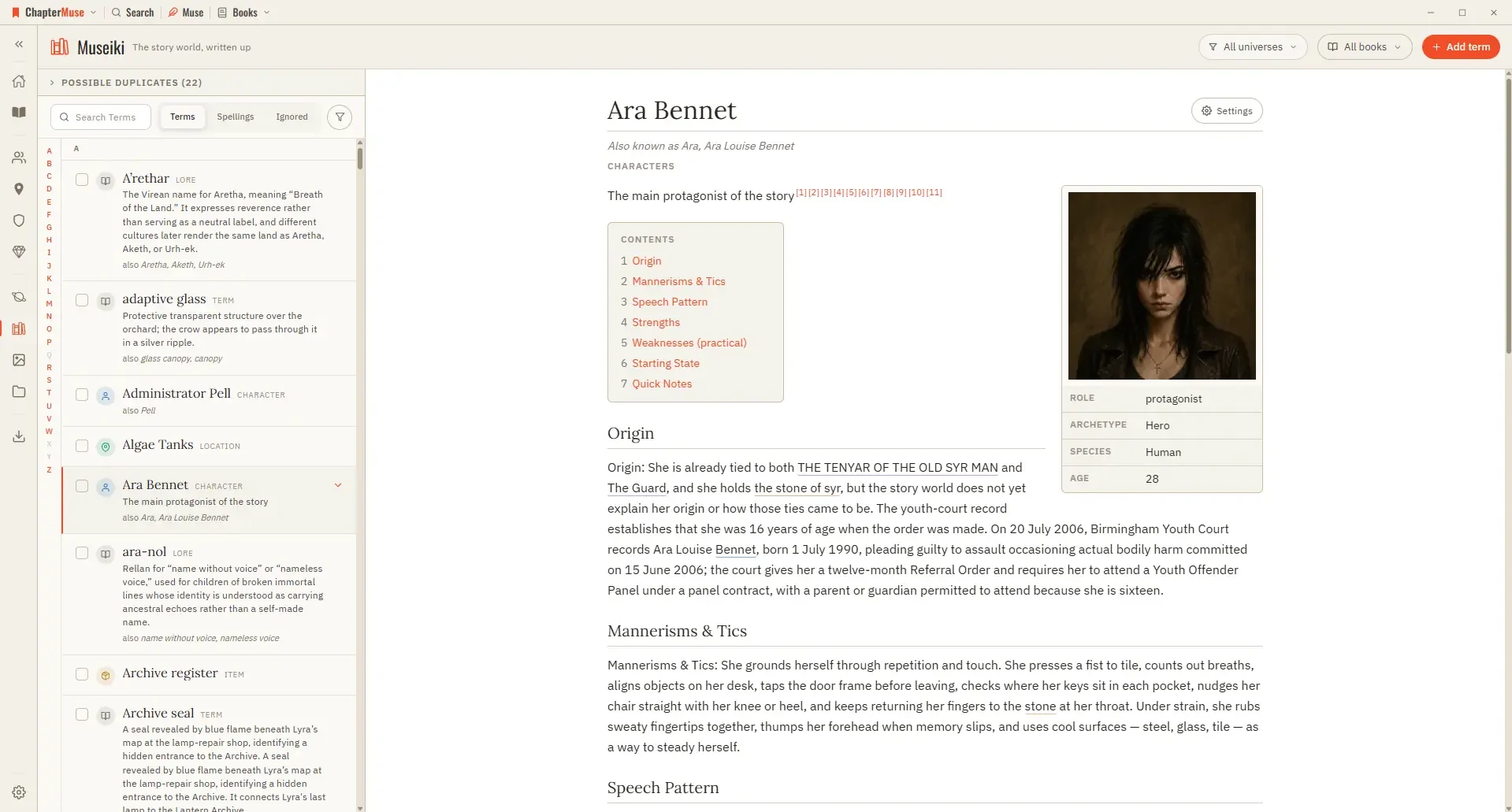
There is a second, sneakier use for a record like this, and it only shows up once the draft is long. Reading your own world back as prose rather than as a set of forms (which is all an encyclopedia view is) makes the imbalance visible. You find four thousand words on a religion the book mentions twice, and one line on the profession your protagonist has done every day for fifteen years. That is not a filing problem. That is a signal about where your imagination has actually been going, and it is usually worth following.
What to do with the chapter you have rewritten four times
Delete the soldiers on the wall. They were never the fix; they were the same paragraph in fancy dress, and it cost you two characters to get there.
Then take the paragraph you originally cut (the one about the succession and the river and the Guild) and go through it a sentence at a time asking who wanted this. Some of it will belong somewhere else in the book, at the page where somebody is stopped at a crossing and cannot pay. Some of it will turn out to be a single vivid noun that can go in chapter one after all, unexplained, held in abeyance, doing more work in three words than the paragraph did in ninety. And some of it (probably more than you expect) will turn out to be something you needed to know in order to write the book, which is a different thing entirely from something the book needs to say.
That is the whole discipline, and it is not really about exposition. It is about who is doing the work. Give the reader a question and they will carry your world for four hundred pages without noticing the weight. Give them an answer first and they will put it down on the third page, politely, and tell you they skimmed a bit.
Sources and further reading
- 01John Clute et al. (eds), The Encyclopedia of Science Fiction, "Infodump": the term's history, including the K. W. Jeter definition from *Dr Adder* (written 1972; published 1984)
- 02Orson Scott Card, How to Write Science Fiction and Fantasy (1990): exposition as "orderly revelation", the principle of abeyance, the Butler reading and the "as you know, Dr. Smith" parody
- 03Octavia E. Butler, Wild Seed (1980): the worked example: an opening sentence that delivers a world and withholds its key term
- 04Jo Walton, "SF reading protocols" (2010): incluing, and worldbuilding as something the reader does
- 05Bram Stoker, Dracula (1897): the documentary structure, and a narrator who records what he cannot interpret
- 06H. G. Wells, The Time Machine (1895): several pages of undisguised lecture that work because they are contested
- 07M. John Harrison, "Very Afraid" (2007), quoted in Helen Marshall, TEXT 24:2 (2020): the reader's part of the bargain; Harrison's own blog is no longer online, so this is the checkable text
- 08Ursula K. Le Guin, From Elfland to Poughkeepsie (1973): the construct built in a void, and why flat "journalistic" prose fails an invented world
- 09Samuel R. Delany, "About 5,750 Words" (1969), in The Jewel-Hinged Jaw: reading as a picture repeatedly corrected: how a science fiction sentence delivers a world word by word
Common questions
- What is an info dump in writing?
- A passage that delivers background information the reader has not yet been given a reason to want: history, world rules, character backstory, technical explanation. The defining feature is not length or form but timing: an info dump serves the writer's eagerness to explain rather than a question the reader is holding. The term goes back at least to K. W. Jeter's Dr Adder, where it is defined as the incompetent writer's way of revealing the details of his story's setting.
- How do I avoid info dumping?
- Build the question before you supply the answer. Practically: go through the passage sentence by sentence and write down, for each one, the question the reader has actually been given on the page. Sentences with no matching question either move to the page where someone needs them, get a question raised earlier, or get cut. Breaking the same unwanted paragraph into six places does not fix it: it distributes it.
- Is it ever okay to just explain something?
- Yes, and the fear of doing so produces its own failure: a coy book where nothing is ever stated. A confident paragraph of narration in the author's voice is honest about what it is, and is nearly always better than a conversation staged between two characters who both already know the information. What readers dislike is not explanation but dull explanation, which is a problem you fix by writing the paragraph better rather than by hiding it.
- What is incluing?
- A term coined by the novelist Jo Walton for scattering pieces of information seamlessly through a text so that they add up to a big picture the reader assembles themselves. Her point is that it is pleasurable rather than merely efficient: the world becomes the mystery, and putting it together is part of what the reader came for.
- Should my main character be new to the world so things can be explained to them?
- Only if they have a reason to be in the book besides needing things explained. Test it by giving them complete knowledge of the world and asking whether they still have wants, refusals and something to lose. Harker in Dracula passes: he has a job, a deadline and a fiancée, and his ignorance is what traps him. A newcomer who exists to ask questions is a camera, and readers notice.