You finished the draft in the spring of the year before last. Since then you have done: what, four passes? Five? You could describe each of them, roughly. There was the one where you fixed the timeline. There was the long one where you went through cutting adverbs and tightening dialogue. There was the one after your friend read it, where you rewrote the opening three chapters, and then the one six months later where you rewrote them again, differently, back towards something closer to the original. The manuscript is not obviously worse. It is also not obviously nearer to being a finished book than it was two passes ago, and you have started to suspect that if you did another five it still wouldn't be.
Everyone told you a novel takes many drafts. Everyone was right, and it is not the useful part of the advice, because it doesn't distinguish between a draft and a lap. A draft moves the book to a state it has never been in before and will not return to. A lap moves it round the same circuit at a slightly different speed. Most stalled revisions are not short of effort. They are short of direction: nobody has told the passes what they are for, so each one quietly reopens decisions the last one made, and the manuscript oscillates instead of settling.
So this is not another argument for doing multiple passes. It is an argument about what has to be true of those passes for the process to have an end.
Four passes is not four drafts if they were all the same pass
Start with the thing nobody says out loud: every decision you make in revision has an altitude, and decisions destroy work beneath them and never above them.
Cutting chapter nine destroys every sentence in chapter nine, including the four you were proudest of. Rewriting a sentence in chapter nine destroys nothing at all: the structure above it doesn't notice. Changing whose head chapter nine is in destroys most of its dialogue and all of its interiority, but leaves the plot standing. Discovering that your protagonist doesn't actually want the thing she says she wants destroys her half of every scene in the book.
Which means the value of any piece of revision depends entirely on whether everything above it has stopped moving. A perfect sentence in a chapter you will cut in April is not slow progress. It is negative progress: it cost you an hour and it made the chapter feel more finished, which makes you less willing to cut it, which is how a book ends up organised around its best paragraphs rather than around its story.
You are not on your fifth draft. You are on your first draft, five times.
Susan Bell, an editor at Random House before she wrote The Artful Edit (2007), splits the whole job into two chapters titled "The Big Picture: Macro-Editing" and "The Details: Micro-Editing", and is emphatic that these are two kinds of reading which cannot be done at the same time. That sounds like a tidy taxonomy until you notice what it implies about how you have been working. You open chapter one intending to look at shape, you hit a clumsy line on page three, you fix it, and forty minutes later you are on page nine doing comma work with no idea any more whether the first act is too long. The pass has silently become a different pass, which is why every pass of yours produces the same mixture of small improvements and unresolved structure.
The second failure is quieter and worse. A structural pass makes decisions: chapter twelve moves, the sister subplot goes, the ending now happens in the flat rather than the hospital. If those decisions live only in the manuscript and not anywhere you can read them, then three months later, working on a different problem, you will make a new decision that contradicts one of them, and you will not notice, because you will be looking at prose rather than at the argument the prose is supposed to be making. Convergence needs a record of what you decided, not just a record of what changed.
Structure, character, scene, line, proof, and the order is not a preference
Here is the order that ends. It is not mine; it is roughly what a publisher does to a book after they buy it, and the reason it looks like that is not tradition but economics: nobody wants to pay a copy-editor to correct commas in a chapter the structural edit is about to delete.
- Structure. Is this the right sequence of events, at the right lengths, with the right things withheld? What is the book about, and does its shape argue for that? This pass moves chapters, deletes chapters, and writes new ones. Nothing below it can be trusted until it stops.
- Character. Given that shape, does each person want something specific, do they get in each other's way, and does the change we are promised actually happen on the page rather than in your notes? This pass rewrites scenes wholesale and occasionally merges two characters into one.
- Scene. Now, scene by scene: does each one turn, does it start late and end early, is anyone in it who doesn't need to be? This is where you fix the four-page conversation that goes nowhere: as opposed to cutting the chapter that contains it, which was the first pass's job.
- Line. Sentences, rhythm, word choice, the tics you cannot see. Now it is safe, because everything this prose is holding up has been settled.
- Proof. Spelling, consistency, the character whose eyes changed colour in chapter six, the em dash you use eleven times on one page. Last, because every pass above it moves text and reintroduces errors.
The professional editing pipeline in Britain is described in almost exactly these terms by the CIEP: developmental or structural work first, then copy-editing, then proofreading as the last quality check before publication, on the explicit understanding that the text has already been thoroughly worked over and moved around. That last clause is the whole point of the ordering. A proofread of a manuscript that is still structurally live is not a proofread. It is a favour you are doing to text that may not survive.
Anne Lamott put the same escalator into three sentences in Bird by Bird, and it is worth having by heart, because it is a description of altitudes rather than of a schedule:
“The first draft is the down draft: you just get it down. The second draft is the up draft: you fix it up… And the third draft is the dental draft, where you check every tooth.”
Notice that the dental draft is third and not first. Everybody quotes Lamott on the shitty first draft and nobody quotes her on the ordering, which is the part that costs you years if you get it wrong.
A pass needs a definition of done and a list of things you refuse to fix
Before you open chapter one, write the pass down as a single sentence in the form: when this pass is over, X will be true. Not "improve act two". Something falsifiable: "when this pass is over, the reader will know what Nadia is hiding by chapter seven instead of chapter fourteen, and nothing before chapter seven will contradict it." You should be able to hand that sentence to somebody else and have them tell you whether you have finished.
Then write the second list, which is the one almost nobody writes and the one that makes the difference: everything you already know is wrong with this book and are not going to touch this time. The flat opening line of chapter three. The friend whose name you hate. The infodump on page ninety. Writing them down is not procrastination; it is the only way to stop them ambushing you, because an unrecorded known problem is a problem your brain will keep offering you every time you pass it, and eventually you will accept the offer, and the pass will dissolve.
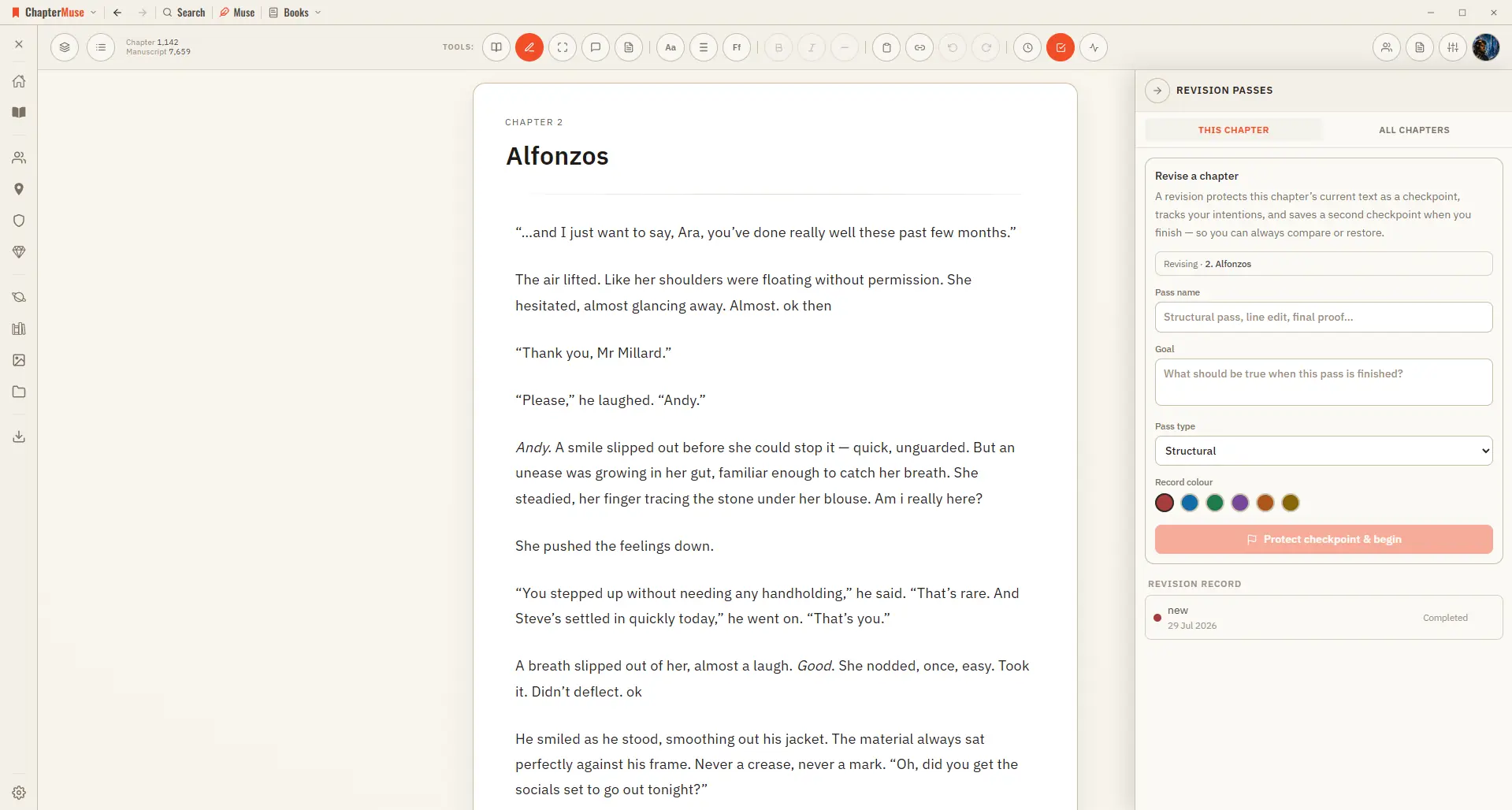
This is harder than it sounds for a reason worth naming. Fixing a sentence is pleasant, immediate and certainly an improvement. Fixing structure is unpleasant, slow, and might be wrong. Given free choice at eleven at night, you will do the pleasant certain thing, every time, for years. The declared pass exists to remove the free choice, which is why it helps to have the pass be a thing that exists outside your head, with a stated goal and a list of the specific effects that have to land, in the way a revision pass does when you name it structural or line or proof and write down what should be true at the end. Anything left undone stays on the record instead of quietly evaporating.
Reverse-outline the book you wrote, not the one you meant to write
The single highest-value instrument in structural revision costs nothing and takes an afternoon. You outline the draft you actually have.
Academic writing centres have taught this for decades: the UW-Madison Writing Center hands out a sheet on reverse outlines to undergraduates, on the grounds that outlining is normally thought of as a planning tool and is in fact far more useful as a revision tool. Fiction has arrived at the same place from the other direction. Matt Bell's Refuse to Be Done (2022) puts it at the hinge between the first draft and the second: map the first draft into a beat sheet, lay that beat sheet against a structure (three acts, braided, episodic, whatever the book is trying to be) and revise the outline until it describes a better novel than the one you have. Mapping his own draft, Bell says, "allowed me to see what was there, what was missing, and what needed to be rearranged."
The mechanics matter, and one of them matters more than all the others. Write one line per chapter, from the text in front of you rather than from memory, and make it a line about what changes: not a summary of events. A plot summary of a bad chapter reads exactly like a plot summary of a good one, which is why summarising your book has never once told you anything.
A summary: tells you nothing
Nadia meets Owen at the boatyard. They argue about the money. She agrees to go to the hearing.
Every chapter in the book can be written like this, including the four you should delete.
A change line: tells you everything
Nadia can no longer claim she didn't know where the money came from. Owen learns she has spoken to the solicitor. Reader now expects the hearing.
Three chapters in a row where you cannot write this line is a found problem, not a feeling.
Then (and this is the part people skip) read only the column. Not the manuscript. Forty lines, top to bottom, in one sitting, and you will see things that are physically invisible from inside the prose: the six chapters where the change line is a variant of "she becomes more suspicious", the subplot that starts in chapter four and is never mentioned again, the fact that your midpoint is at sixty-eight per cent. If what you find is a long flat run rather than a single broken join, the sagging middle diagnostics are the right next tool, and if it is a run that is technically eventful but reads slack, the question is more likely to be what editors mean by pacing.
Matt Bell's second draft: don't edit it, retype it
Which brings us to the most radical piece of practical revision advice in current circulation, and the one that sounds insane for about ninety seconds and then doesn't. Bell's second draft is not an edit of the first draft. It is a retype of the whole novel from a blank document.
The old draft goes on one screen. A new, empty file goes on the other. You work forwards through the revised outline, retyping every word you keep and striking through the source as you consume it, so the first draft becomes what Bell calls a diminishing draft: it shrinks towards nothing while the real book grows from zero beside it. It takes about as long as writing the first draft did.
What makes it work is an inversion of the default. In ordinary editing, text is retained unless you act to remove it; cutting requires a decision, an act of will, and a small bereavement. In a retype, text is removed unless you act to retain it: every sentence must be re-earned by somebody typing it out again. Three years of accumulated sunk cost is neutralised at a stroke, not by willpower but by mechanics. And prose you wrote while working out what the book was (the scaffolding, the two paragraphs of backstory you needed and the reader never did) becomes conspicuous the moment you have to retype it:
“Especially all that explanation and exposition that you do as you're figuring the book out: that stuff becomes really obvious when you retype the second draft.”
It is not for every book and it is certainly not for every pass. A manuscript whose structure is sound and whose problem is that thirty pages are dull does not need to be retyped; that is a scene pass with a scalpel. But if your reverse outline came back saying the sequence is wrong, the viewpoint is wrong, or the book is about something other than what you thought (if the honest verdict is that the next version shares a premise with this one and not much else) then retyping is not the expensive option. Trying to reach that book by successive amendment is the expensive option, because amendment tends to preserve exactly the structure you are trying to leave.
You can only be brutal if the old version survives
In May 1980 Raymond Carver sent his editor Gordon Lish the manuscript of a new collection, and told him in a covering letter not to worry about taking a pencil to the stories if he could make them better. Lish took a pencil to them. Across two rounds of line-editing he cut the book's word count by fifty-five per cent. "A Small, Good Thing" went from thirty-seven typescript pages to twelve and was renamed "The Bath". The title story, "Beginners", went from thirty-three pages to nineteen and became "What We Talk About When We Talk About Love".
Carver read the second edited version on the 7th of July, sat up all night with it, and at eight the following morning wrote Lish a letter that is one of the most painful documents in modern American publishing: full of gratitude, self-abasement and terror, insisting the edits were brilliant and that he could not live with them. It ends with a postscript.
“Please do the necessary things to stop production of the book.”
Production was not stopped. Lish's account, given to The New York Times Magazine eighteen years later, was that there was a letter and he just went ahead. The book came out, made Carver's reputation, and is still taught as a landmark of American minimalism. Whether it is Carver's book or Lish's has been argued ever since, and the reason it can be argued is the part that matters for you. Lish's marked-up typescripts survived, in the Lilly Library at Indiana University, with Carver's original words legible underneath the ink. In 2009 the Library of America published the restored versions as Beginners. Two states of the same book, both readable, thirty years apart.
Courage in revision is a storage problem before it is a temperament problem.
Almost every writer who cannot bring themselves to make a large change is really reporting a fear of irreversibility. You will not delete the subplot because if the book is worse without it you will have destroyed a year. That fear is rational when the change is genuinely one-way and irrational when it isn't, and the difference is entirely a matter of whether the previous state still exists somewhere you can find it. Note, too, that Carver's objection was structural rather than sentimental: the pared stories, he wrote three days later, might be left with "not enough connecting tissue". He may well have been right, and nobody could examine the claim at all if the earlier version had been thrown away.
So the practical discipline is dull and it is the thing that makes everything else in this article possible: take a copy of the manuscript as it stands the moment before a pass begins, name it after the pass rather than after the date, and never edit that copy. This is the single reason automatic chapter history is worth more than it looks: not because you will often go back, but because knowing you could is what lets you cut the chapter. Writers with reliable version history make bigger, faster, better structural decisions than writers without it, and it is not close.
Readers are reliable about problems and unreliable about solutions
The other great engine of non-convergence is other people. Four readers, four sets of notes, and at least two of them contradict each other outright: one wants more of the sister, one thinks the sister is a distraction. Try to satisfy both and you get a book that does neither thing well, and a fifth pass undoing the fourth. Satisfy whichever note arrived most recently and your novel is now being steered by the reading order of your inbox.
“When people tell you something's wrong or doesn't work for them, they are almost always right. When they tell you exactly what they think is wrong and how to fix it, they are almost always wrong.”
Treat every note as a coordinate rather than an instruction, and contradictory feedback stops being contradictory almost immediately. Your four readers disagreed about the remedy. Check whether they disagreed about the location. If three of them slowed down somewhere in chapters eleven to fourteen and offered three different explanations (too much sister, not enough sister, the weather descriptions) then the finding is chapters eleven to fourteen, and all three explanations are guesses made by people who are not novelists and were never asked to be. Consensus on where is evidence. Consensus on why is a coincidence, and it is rarer than you think.
The classic demonstration is in the file. On the 20th of November 1924, Maxwell Perkins wrote to F. Scott Fitzgerald about the typescript of The Great Gatsby, and among a great deal of praise made one central objection: Gatsby himself was "somewhat vague", and "the reader's eyes can never quite focus upon him, his outlines are dim". Perkins then proposed remedies. Describe him physically, as distinctly as the others. Sketch in some hint of the business he is in. He also noted, with the honesty of a good editor, "a certain slight sagging in chapters six and seven", and admitted he did not know how to suggest a remedy for it.
Fitzgerald accepted the problem and mostly declined the solution. He never did give Gatsby a proper physical description: the man remains a rumour, which is the point of him. What he did instead was tear into the galley proofs over that winter, rewriting and reordering chapters six, seven and eight, and completely redistributing the revelation of Gatsby's past so that it comes out through the narrative in pieces rather than sitting in one block of exposition. The version that went to the printer as Trimalchio and the novel we have are different books in their middle. Perkins had located a real defect and prescribed the wrong drug; Fitzgerald kept the diagnosis and threw away the prescription, and the diagnosis was worth more than the prescription would have been.
One caveat, because the rule is easy to abuse. "Readers are unreliable about solutions" is not permission to bin every note you dislike. The note to be most suspicious of is not the one you disagree with: it is the one you disagree with that lands squarely on a page you were already privately uneasy about. That is not a reader being wrong. That is a reader finding the thing you have been walking around for two years.
Finished is a decision, and most books are abandoned at a good moment
The line everyone knows is Valéry's: a work is never finished, only abandoned. What is nice about it, given the subject, is that the famous version is itself an edit. Valéry wrote something longer and more qualified in a 1933 essay about his own poem (that to those who anxiously seek perfection a work is never achevé, a word which for them has no meaning, but abandoned) and a journalist reprinting the piece two months later cut the middle out and produced the crisp aphorism we all quote. Somebody line-edited Valéry's remark about never being finished, improved it, and that is the version that survived.
The reason the idea sticks is that it is true and slightly humiliating. There is no state a manuscript reaches in which it stops being improvable. Waiting to feel finished is therefore not a plan, and Zadie Smith says the cruellest version of this out loud in "That Crafty Feeling", her 2008 lecture at Columbia. Her section on the end of a novel is titled "Step Away from the Vehicle", and her advice is to put the finished thing in a drawer (three months minimum, a year if you can stand it) so that you come back to it as its reader rather than its writer, with, as she puts it, the head of a smart stranger who picks it off a shelf and begins to read.
“The perfect state of mind to edit your own novel is two years after it's published, ten minutes before you go onstage at a literary festival.”
Which is a joke with a working method inside it. You will never have the ideal distance while the book is still yours to change, so you buy the closest approximation you can (weeks or months of genuine separation before each major pass) and then you accept that the last few per cent of clarity is simply not purchasable and stop trying to buy it.
What does the end actually look like, then, from inside? Convergence has a signature, and you can watch for it. Each pass should cost more effort and return less change than the one before. The notes you make on your own manuscript should be getting smaller: from "act two is the wrong shape" to "chapter fourteen is one scene too long" to "this paragraph, twice". Your changes should stop being lateral: when you find yourself swapping an adequate word for a different adequate word, and then swapping it back the following week, that is not polishing, that is the manuscript telling you it has run out of things to give you.
If instead each pass is turning up problems the same size as last time's, the book is not converging and no amount of further passes will make it: something above the level you are working at is still wrong, and you should go back up the ladder rather than round the loop again. That is the whole diagnosis in a sentence, and it applies just as well at the end as at the beginning.
And then, at some point, you will have a book that is better than the last version, that you can no longer see clearly, and whose remaining flaws you have looked at so many times that they have become invisible furniture. Run the proof pass (genuinely last, genuinely mechanical, the chapter check sort of work rather than anything requiring judgement) and let it go. Not because it is perfect. Because you have reached the point where the next pass would cost six months and buy you a sentence, and there is another book, and that one still has all its possibilities open.
Sources and further reading
- 01Susan Bell, The Artful Edit: On the Practice of Editing Yourself (2007): macro-editing versus micro-editing as two kinds of reading that cannot be done at once
- 02Anne Lamott, Bird by Bird (1994): the down draft, the up draft and the dental draft: an ordering, not a schedule
- 03Matt Bell, Refuse to Be Done: How to Write and Rewrite a Novel in Three Drafts (2022): mapping the first draft, the revised narrative outline, and the retyped second draft
- 04"Reverse Outlines", UW-Madison Writing Center: outlining used as a revision instrument rather than a planning one
- 05"Note on the Texts", Raymond Carver: Collected Stories (Library of America, 2009): Lish's 55% cut, the surviving typescripts, and Carver's letter of 8 July 1980 in full
- 06Maxwell Perkins to F. Scott Fitzgerald, 20 November 1924: "Gatsby is somewhat vague": a correct diagnosis attached to a remedy the author refused
- 07Zadie Smith, "That Crafty Feeling" (2008), collected in Changing My Mind: "Step Away from the Vehicle": the drawer, and reading your own book as a smart stranger
- 08Neil Gaiman, "Ten rules for writing fiction", The Guardian (2010): readers are almost always right about the problem and almost always wrong about the fix
Common questions
- How many drafts does a novel need?
- The number is the wrong unit: what matters is how many distinct altitudes you have worked at. Matt Bell argues a novel can be done in three: an exploratory first, a retyped second built from a revised outline, and a third made of narrow polishing passes. Plenty of writers take more. But five passes that were all the same pass count as one, which is why writers who have "done nine drafts" are often still on their first.
- In what order should I revise a novel?
- Structure, then character, then scene, then line, then proof. The reason is that work at each level is destroyed by changes at the level above it and never the other way round, so line-editing a chapter you will later cut is not slow progress but wasted progress. It is roughly the order a publisher applies to a book after acquisition, for exactly the same economic reason.
- What is a reverse outline, and how do I do one for fiction?
- You outline the draft you actually wrote rather than the one you planned. One line per chapter, taken from the text rather than from memory, and (this is the part that makes it work for fiction) the line should name what changes, not summarise what happens. Then read only the column, in one sitting. Chapters where you cannot write the line, and runs where three lines say the same thing, are the structural findings.
- What do I do when beta readers give me contradictory feedback?
- Look for agreement about location rather than agreement about cause. Readers are reliable when they report that something went wrong and where; they are unreliable when they explain why or prescribe a fix, because diagnosing fiction is a different skill from reading it. If three readers slowed down in the same four chapters and gave you three different reasons, the four chapters are the finding and the three reasons are noise.
- How do I know when my novel is finished?
- You do not reach finished; you reach the point where stopping is the better decision. Watch for the signature of convergence: each pass costing more and returning less, your own notes shrinking from structural to local, and changes turning lateral: swapping one adequate word for another and swapping it back next week. If instead each pass finds problems the same size as the last, the book has not converged and something above your working altitude is still wrong.