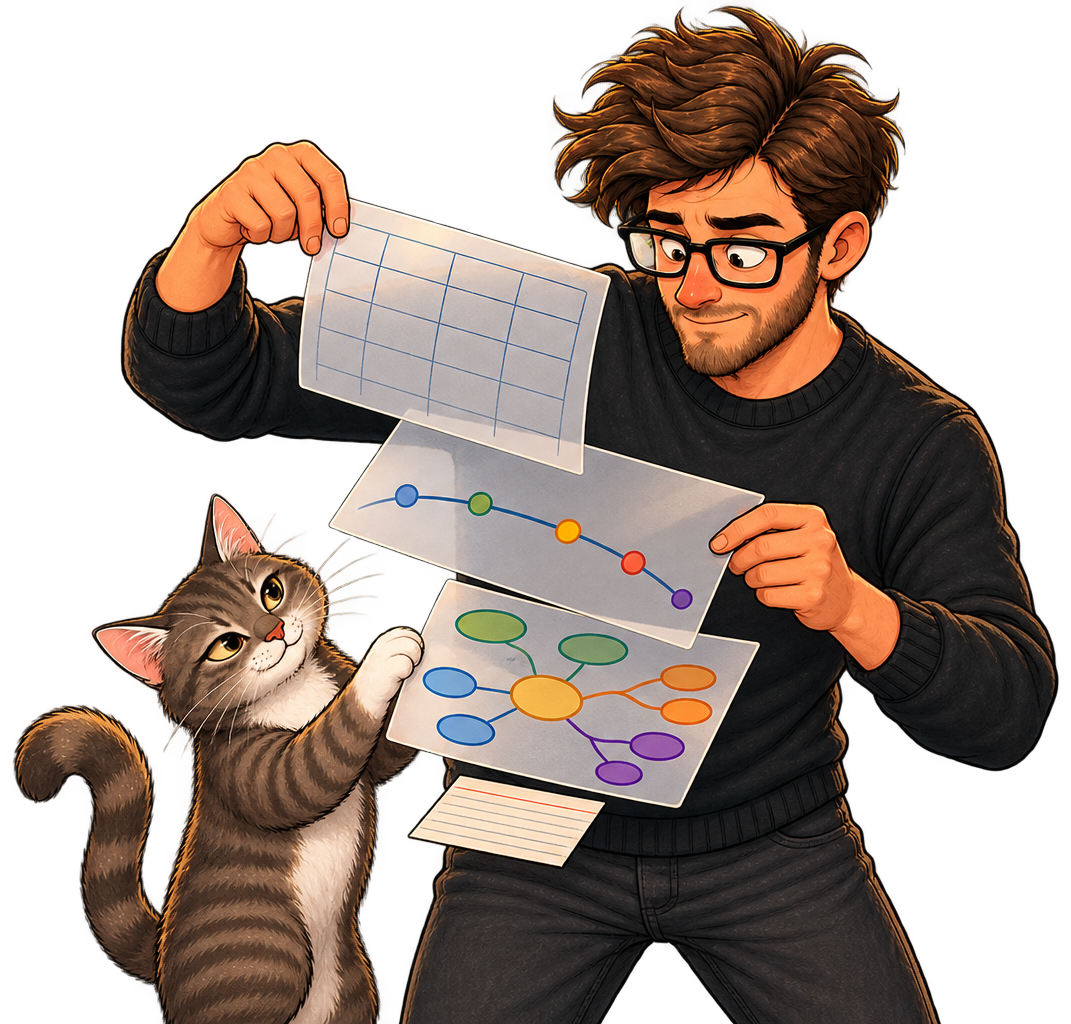
You have forty chapters and a feeling. Something in the second half is wrong. You cannot hold forty chapters in your head at once, so you go looking for a way to see the book from above, and the internet offers you a plot grid, a timeline, a mind map, a beat sheet, a corkboard and a spreadsheet, all of them described as essential by somebody selling one.
They are not competing products, and none of them is the serious writer's choice. They are three different flattenings of the same book, and each throws away most of it in order to make one thing visible. The grid throws away time. The timeline throws away everything except sequence. The mind map throws away order altogether. Pick the one that discards what you do not currently care about, and the answer tends to be sitting there in about ten minutes. Pick the wrong one and you will spend a fortnight producing a beautiful diagram of the thing you already understood.
So this is not an article about which view is best. It is about how to tell which question you are stuck on, because that is the part writers get wrong, and the views themselves are simple enough to learn in an afternoon.
A grid answers where a thread went quiet
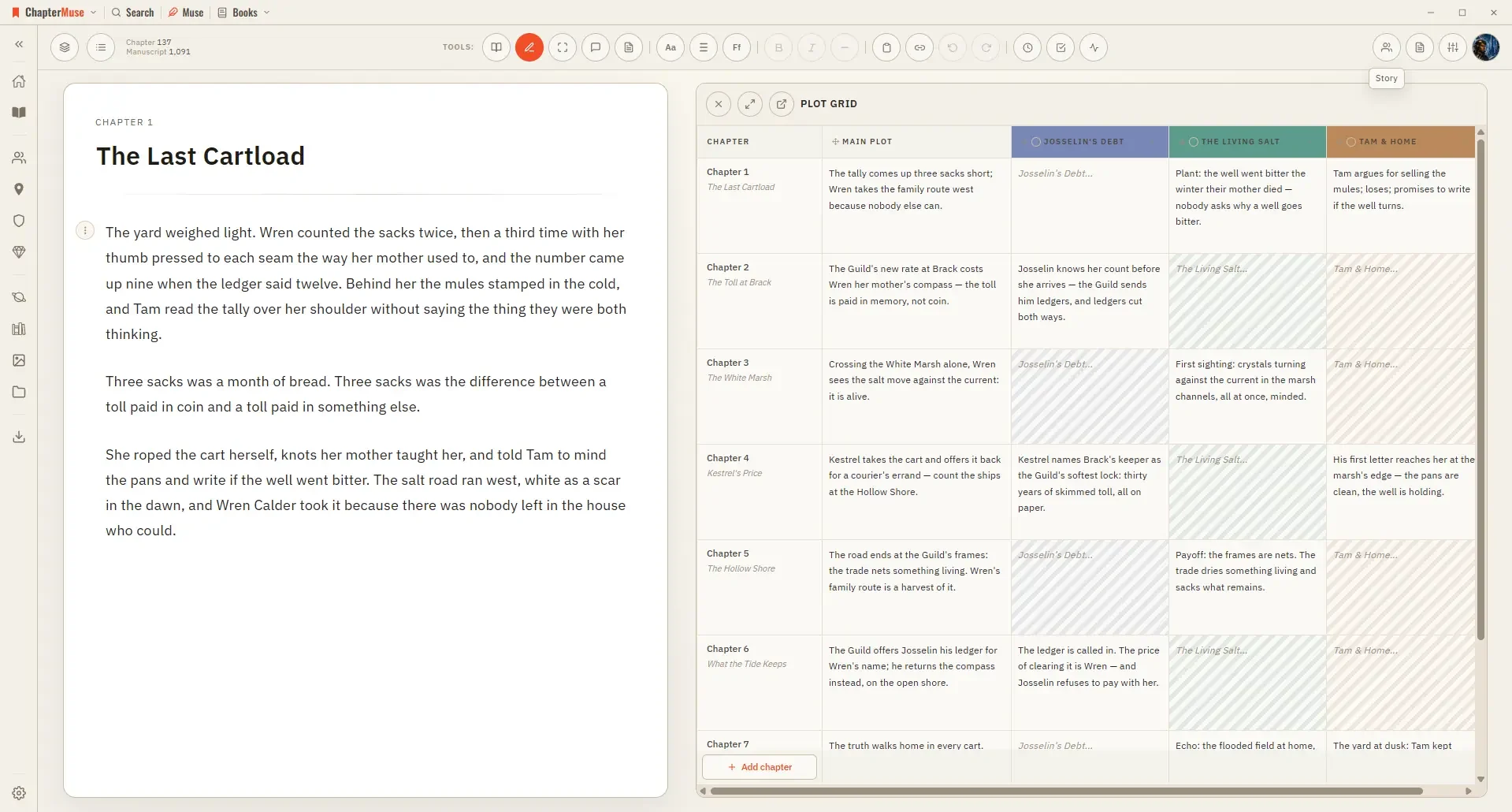
The most famous planning document in modern publishing is a single sheet of lined paper. J.K. Rowling drew it by hand while writing Harry Potter and the Order of the Phoenix, and the surviving page covers chapters thirteen to twenty-four. Down the left are the chapters. Across the top are the subplots: the Prophecy, Cho and Ginny, the D.A., the Order of the Phoenix, Snape and Harry, Hagrid and Grawp.
That is a plot grid, and it is the whole idea. One axis is the book in order. The other axis is the things you are worried about. Every cell asks the same small question: what is this thread doing here?
What makes it powerful is not the filled cells. It is the empty ones. A column with nine consecutive blanks is a subplot the reader has not thought about since chapter fourteen, and you will almost never notice that by rereading, because rereading is sequential and the gap is only visible from above. This is the same failure the sagging middle is usually made of, seen through a different instrument.
Rowling's grid also records what is happening off the page: what the Order is doing while Harry is in detention. That is the second thing a grid is good for. A subplot has a life the reader does not see, and keeping a column for it is how you avoid the version where a character sits in a cupboard for nine chapters and then walks in with exactly the information the plot needed.
A timeline answers when, not in what order you tell it
Joseph Heller's outline for Catch-22 is a grid too, but rotated into a different question. Its rows run down through time, early 1944 at the top to December 1944 at the bottom. Its columns are the major characters. In the cells he wrote what happens to whom and when: the chaplain seeing Yossarian naked in a tree and taking it for a vision, Milo justifying the bombing of his own squadron in terms of free enterprise, Snowden shot through the middle and dying.
Look at what that made possible. Catch-22 is told in a deliberately scrambled order: its whole effect depends on circling the same events and only revealing what happened to Snowden at the very end. You cannot improvise that. To scramble chronology on purpose you must first know the chronology exactly, and a chart like Heller's is where you keep the true order while the book tells a different one.
To break the order on purpose, you first have to know it exactly.
This is the distinction people miss when they say a timeline is only for historical or time-travel novels. Story time and reader time are two separate sequences in every book. Any novel with a flashback, a withheld revelation, a dual timeline, or two characters who meet in chapter thirty having each had a chapter one, is running both at once. A timeline view is the only one of these three that can show you both and the gap between them.
It is also the only one that catches the dull, book-ruining errors: the pregnancy that lasts fourteen months, the character who is nineteen in spring and twenty-three by autumn, the journey that takes four days going and an afternoon coming back. Nobody reads their own manuscript looking for those. A chronological axis finds them because it forces every event to declare a position.
Grid: chapters × threads
Shows: where a thread appears and where it vanishes.
Hides: how much time passes, and what order events really happened in.
Ask it: why does the middle feel slack?
Timeline: time × people
Shows: when things happened, how long they took, who was where.
Hides: the reader's experience, which is a different sequence entirely.
Ask it: does the chronology hold up, and am I revealing it in the right order?
A mind map is for the stage before there is an order
The third view is the odd one out, and the honest thing to say about it is that its evidence base is thinner. There is no famous novelist's mind map in an archive. What there is instead is a long tradition of writers deliberately refusing to fix an order until late.
Nabokov wrote Lolita on lined Bristol index cards, in pencil, and not in the book's order. He described having the whole thing mapped out in his head and then filling in the gaps wherever he happened to feel like starting. The cards at the Library of Congress and the Berg Collection show him reordering them repeatedly. The point of a card is that it has no position until you give it one.
“I don't begin at the beginning; I fill in the gaps of the crossword at any spot I happen to choose.”
That is the mind map's actual job. Not to be a prettier outline, but to hold ideas in a state where they are still allowed to be connected to each other rather than to a chapter number. When you do not yet know whether the sister is a subplot or the whole book, putting her in row nineteen of a grid is a decision you are not ready to make. Putting her on a canvas with lines to three other things is not a decision at all, which is the correct amount of commitment at that stage.
The failure mode is obvious once you name it: a mind map never tells you that you are finished. A grid has empty cells, a timeline has gaps and collisions, and both of those are shaped like problems. A web of connections always looks rich. If you have been mind-mapping the same novel for six months, the map is no longer doing the work you think it is.
Choose by the question you cannot currently answer
Here is the whole method, and it fits in a sentence: say the problem out loud, and the grammar of the sentence tells you which view to open.
- A where question: "where did the sister go?", "where does the theme stop being present?": is a grid. You need chapters against threads.
- A when question: "how old is he here?", "has enough time passed for that wound to heal?", "when does the reader learn this?": is a timeline.
- A what connects to what question: "is the sister's story the same story?", "why do these two ideas feel related?": is a map, or index cards, or the floor of your study.
- A why does this scene not work question is none of them. That is a scene problem, and no aerial view has ever fixed one. Go and read the scene itself.
That last one matters more than the other three. The overhead views are diagnostic instruments for problems that live between chapters. A great many writers open a planning view because a specific scene is bad, and no arrangement of boxes will tell them that the dialogue is on the nose.
Keeping all three up to date is a way of not writing
Every one of these views is a copy of your book, and every copy has to be maintained or it starts lying to you. Three copies is three maintenance jobs, and the moment a view disagrees with the manuscript it is worse than not having it, because you will trust it.
The version of this that hurts is subtle: you rewrite chapter twenty-two, the grid still describes the old chapter twenty-two, and six weeks later you make a structural decision based on a cell that has been wrong since April. This is the same argument as the one for keeping a story bible honest, and it has the same answer: the record has to be cheap to update, or it will not be updated.
This is genuinely the strongest practical case for planning views that read the manuscript directly rather than being drawn separately: when the grid, the timeline and the chapters are three views of one set of records, rewriting the chapter is the update. Rowling's sheet of paper had to be redrawn by hand. That is fine for one book and one author; it is not a system.
But the sharper answer is simply to use fewer of them. Most novels need one overhead view, chosen for the problem that book actually has. A quiet domestic novel with a large cast and no time tricks needs a grid and will never need a timeline. A dual-timeline thriller needs the timeline and may never need anything else. Maintaining all three because a blog said they were essential is how planning becomes a hobby that resembles writing.
What to do with the chapter you are stuck on
Write down, in one sentence, what you cannot currently answer. Not "the middle is weak": that is a feeling, not a question. Something you could be right or wrong about: has Marianne been off the page for six chapters? Is it possible for him to reach the coast by Thursday? Are the two halves of this book about the same thing?
Then build only enough of the relevant view to answer it. Not the whole novel: the fifteen chapters the question touches. You are not making an artefact, you are running a test, and the test is finished when you know the answer. The grid you draw to check one thing in twenty minutes is worth more than the beautiful one you maintain for a year, because you will actually look at it, once, at the moment it matters, and then go back to writing chapter nineteen.
Sources and further reading
- 01J.K. Rowling's handwritten plot spreadsheet for Harry Potter and the Order of the Phoenix: chapters down the side, subplots across the top, including what happens off the page
- 02Joseph Heller's handwritten outline for Catch-22: rows run early 1944 to December 1944, columns are the major characters
- 03Joseph Heller's Catch-22 manuscript and correspondence, Brandeis University Archives: where the Catch-22 papers are held
- 04The notecards on which Vladimir Nabokov wrote Lolita: composition out of order on lined Bristol cards, reordered repeatedly
- 05Vladimir Vladimirovich Nabokov Papers, Library of Congress: one of the two archives holding the manuscript cards
Common questions
- What is a plot grid?
- A table with your chapters on one axis and your storylines on the other, so each cell records what a given thread is doing in a given chapter. Its real output is the empty cells, which show where a thread has gone quiet.
- Do I need a timeline if my novel is not historical?
- Only if story time and reader time differ, which is most novels. Any flashback, withheld revelation or dual timeline means you are running two sequences at once, and a timeline is the only view that shows both.
- Is a mind map useful for plotting a novel?
- It is useful before you have an order, when the value lies in finding connections rather than fixing positions. It is much weaker later, because unlike a grid or a timeline it has no shape that looks like a problem, so it never tells you when you are done.
- Should I keep all three views for the same book?
- Usually not. Each is a copy of your manuscript that has to be maintained or it starts lying to you, and a stale planning view is worse than none because you will trust it. Most books need one, chosen for the problem that book actually has.