You have rewritten your first page more times than any other page in the book. You know the first line by heart, you have read it aloud to someone who loves you, and you have cut it by a third twice. It still comes back as a form rejection with a sentence in it about how subjective this business is.
The trouble is that you have never been able to read that page the way it is going to be read. You know who the woman on it is, what the box contains, what the word sennight means in your world. A stranger, reading at speed at the end of a day in which they have already read forty other first pages, knows none of it and is not going to ask.
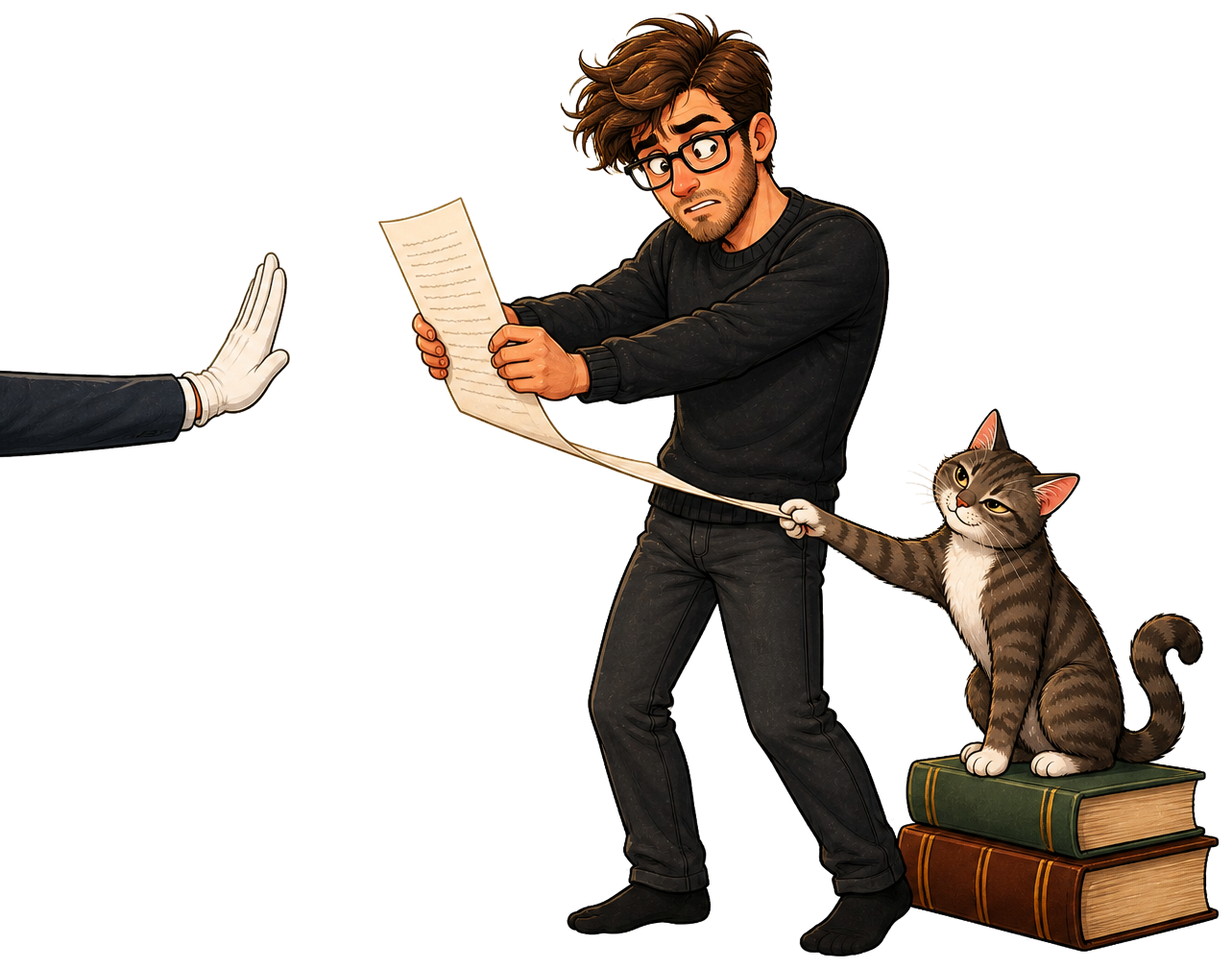
There is a running event at the Boston Book Festival called Writer Idol that makes this brutally literal. An actress picks manuscripts at random and reads the first 250 words aloud; a panel of agents listens, and the moment any of them would have stopped, they put a hand up. Livia Blackburne wrote up one of these sessions for Writer's Digest: Esmond Harmsworth, Eve Bridburg and Janet Silver of Zachary Shuster Harmsworth, plus Helene Atwan of Beacon Press. Her estimate of how many submissions reached the end of their own 250 words: fewer than a quarter.
That is a horrible thing to read at eleven at night with your own first page open. It is also the most useful fact about openings I know, because it says what the page is really tested for. Not quality. Not even interest. It is tested for whether a stranger reading fast, with no goodwill, can stay oriented and stay curious at once, and almost every failed opening sacrifices one to buy the other.
Page one answers three questions, and the order matters
Before a reader can care, they have to be somewhere. Your first page is doing three jobs, and they are not equally urgent: who am I with, where are we, and why should I believe something is about to become difficult for this person. In that order, which is not the order most drafts serve them in.
The first is non-negotiable and the most commonly fumbled. The editor Alyssa Matesic puts it plainly in her list of first-page mistakes: "If I can't tell whose perspective I'm following by the end of the first page, I won't feel connected to the story." Her other diagnosis is the page that "ends up feeling like it's happening in a void": dialogue with nobody standing anywhere.
The third job is the one writers hear as "hook" and go badly wrong on, so let me phrase it in a way that is harder to misread. You are not required to make something happen on page one. You are required to make the reader believe something is about to cost somebody something. Here is all three, in two sentences, by a novel that opens with the weather.
There was no possibility of taking a walk that day.
I was glad of it: I never liked long walks, especially on chilly afternoons: dreadful to me was the coming home in the raw twilight, with nipped fingers and toes, and a heart saddened by the chidings of Bessie, the nurse, and humbled by the consciousness of my physical inferiority to Eliza, John, and Georgiana Reed.
Look at what the first sentence is not. It is not a description of weather: no rain, no wind, no sky. It is a consequence (a possibility removed from somebody) and the weather does not arrive until halfway through the sentence after, by which point it has already been given a job. That is the whole difference between weather that works and weather that gets a hand up. Not whether it is there. Whether it takes something from a person in the same breath.
Then "I was glad of it": six words, and the who is settled. There is an I, the I has an opinion, and the opinion contradicts the one we were about to assume: nobody is glad to be shut indoors. The reason unfolds into a domestic hierarchy a modern manuscript would spend four paragraphs on: a nurse who chides, three cousins she is measured against and comes last to, and the word inferiority doing more work than any amount of backstory could.
Five proper nouns in one sentence, which the next section is about to call dangerous. Notice how Brontë gets away with it: each arrives welded to a role and a feeling. Bessie is the nurse, and she chides; Eliza, John and Georgiana are the ones the narrator is inferior to. You are not asked to remember them, only to notice what it is like to be her. Nothing has happened. Everything is in place.
What gets you rejected is confusion, not boredom
Writers brace for "it was boring" and are usually surprised by what agents report from the slush. At the Women in Publishing Summit, four agents read submitted opening pages cold and said where they would have stopped; Shawna Hampton's write-up of the session has the most quotable version of the top complaint I have found. Their recurring problem was not that pages were dull. It was that pages made them work.
“It adds more brain power to have to figure it out, and that will turn off some readers.”
The same agent was blunter about where it concentrates: "It's really important, especially in fantasy, that you are describing things in a way that is inviting the reader into it instead of just throwing terms and expecting us to figure it out."
The mechanism matters, because "don't confuse the reader" is not actionable and the mechanism is. A reader assembles a working model as they go (who exists, what things are called, what is happening) and holds all of it at once. Every unfamiliar proper noun is a placeholder they must carry, unresolved, until you say what it attaches to. Placeholders are almost free to write and expensive to hold, and that asymmetry is the whole problem.
So the terms are not forbidden. They have a budget, and it is small: realistically about one unresolved item per paragraph. Five names in two paragraphs blows it; so does a place name, a rank, a god and a currency in one sentence. And most manuscripts spend it on things that are not load-bearing at all: the barman named once, the aunt who never returns, the guards who exist so the corridor has people in it.
Head-hopping the same panel treated as a different order of offence. One agent's verdict on a page that slid between three viewpoints: "There were three instances of head hopping on the first page. Automatic no for me." That sounds like snobbery about a rule and it isn't. On page one, the model the reader is building is the model of whose story this is, so a slide does not merely confuse them, it withdraws the offer while they are still deciding whether to accept it. On page ninety it is a wobble; here it says the book does not know who it belongs to, and the repair is a decision about distance rather than a rule about pronouns.
The cure is not explanation: that is the reflex, and it produces the other kind of dead page. It is anchoring, and it is worth watching a writer do it with something genuinely hard to explain.
The Time Traveller (for so it will be convenient to speak of him) was expounding a recondite matter to us. His grey eyes shone and twinkled, and his usually pale face was flushed and animated. The fire burned brightly, and the soft radiance of the incandescent lights in the lilies of silver caught the bubbles that flashed and passed in our glasses.
Wells is about to spend six pages on four-dimensional geometry, roughly the most demanding premise you could hand a Victorian reader, and the reader never works for it. The parenthesis pre-empts a question rather than leaving it to nag: this man has a name, you will not need it, somebody is telling you all this afterwards. Compare the manuscript that calls a character the Warden for nine pages and expects you to enjoy not knowing why.
There is also not one proper noun in the first sixty words (everyone is named by function, the Psychologist, the Provincial Mayor, the Very Young Man) because a name is a memory cost and a function is free. And Wells spends his budget on the room, not the idea: a fire, glasses, chairs, the slackness of people who have eaten well. When the argument starts it arrives as dialogue with an interrupter in it. Filby objects. The idea is tested in front of you rather than delivered to you, which is the whole trick of getting information into a novel without stopping it.
An unexplained word inside a concrete situation is intrigue. The same word inside an abstract one is homework.
Litopia's Pop-Up Submissions does publicly what the slush panels do privately, and the science-fiction episodes are the instructive ones.
"Start with action" is the worst good advice in publishing
The advice is not wrong. It is wrecked by a single word. Les Edgerton, whose Hooked is the most useful book-length treatment of openings I know, spent a good deal of his teaching life on exactly this: writers hear action the way a film trailer means it.
“Dialog is action, for instance. A character driving down the road and seeing a dead plover is also action. A character reading a newspaper on the subway is action.”
His verdict on the damage ("This one misunderstood term is to blame for many of the mistakes made in creating a manuscript") is the polite version. The impolite version is that a great many opening chapters contain a car chase the writer did not want to write and the book does not need, bolted on because somebody said start with action.
And it fails for reasons of arithmetic rather than taste. Jane Friedman lists the crisis opening among her story openings to avoid because an unexplained emergency "may not raise any interesting questions or reasons to keep reading if there's not sufficient context". Her name for the result (false suspense) is exact. Suspense is the anticipation of a cost, and to anticipate a cost you have to know who pays. A stranger in a burning car is not suspense. It is motion.
Action
Three men came through the door with guns. Cal went over the counter and the window blew in behind him.
Nothing here can cost you anything, because you have not been told what Cal has to lose or who he is. It is a stunt sequence with a name in it.
Tension
Cal counted the till twice, because the second count was the one he would have to say out loud to his brother.
One small act, no danger at all, and already there is a shortfall, a brother, and a conversation coming that Cal is dreading.
Kristin Nelson put a related trap at the top of her list of culprits for why agents stop reading: the chapter opens on action, gets two paragraphs in, then stops dead so the viewpoint character can reflect on how they came to be here. "It's a passive way to begin a story," Nelson writes, "and means you've started in the wrong place." The tell is diagnostic. If your opening action needs a paragraph of explanation immediately after it, the reader needed that explanation before it, so it was never the beginning. It was the second beat, written in the wrong tense.
The honest rewrite: open on somebody wanting something, in a place, where wanting it is going to cost. That is what a scene is, and it is the same test at chapter scale as at scene scale: what was possible when we came in that will not be possible when we leave.
Wake-ups, weather and mirrors fail for three different reasons
Every list of forbidden openings contains the same four or five items, handed down like a superstition. The Writer Idol tally included "a young woman looks into the mirror and tells us what she sees"; Harmsworth's line about weather is the most-quoted sentence in the write-up: you are only allowed to start with the weather if you're writing a book about meteorologists. Laurie McLean of Foreword Literary, in the survey reprinted as the worst ways to begin your novel, dislikes "opening scenes that you think are real, then the protagonist wakes up".
But the list is useless without the reasons, and the reasons are not the same reason. Told your opening is a cliché, you swap it for a different one, which is how the dream sequence becomes a funeral. What you want is the underlying fault, because the fault survives the swap.
Waking up
Not overdone. Empty. A person surfacing into consciousness has, by definition, not yet wanted anything, chosen anything or resisted anything. You have opened at the one moment in the day when your character is least themselves, so everything the page needs has to be imported afterwards as reflection, which is why waking-up openings are so reliably followed by three paragraphs of backstory. The alarm clock is not the problem. The zero is.
Weather
Fails when it is the author clearing his throat: camera position established before anyone walks on. Brontë passes because her weather does something to a person in the clause it appears in, and that test applies literally. Read your first weather sentence and ask what it takes away from somebody. If the answer is nothing, it is a lighting note, and lighting notes are what you write while working out where the scene starts.
The mirror
Fails because it is a point-of-view violation dressed as description. Nobody catalogues their own face. The writer needs the reader to see the character, has chosen a viewpoint that will not permit it, and wheels in a reflective surface to solve a technical problem, and the reader feels the machinery move. It is not the mirror that is banned. It is the visible seam where the narration stops serving the character and starts serving you.
The dream
Fails on contract. You offered stakes and withdrew them on page one, before the reader had any evidence that you can be trusted, and what they learn is that this book will lie for effect.
Every clichéd opening is the same mistake wearing a different hat. It is a run-up.
Waking, dressing, driving to work, remembering, dreaming: all of them are ways of not starting yet. They exist because you needed a running start, which is a legitimate thing to need while drafting and an illegitimate thing to leave in.
The prologue question, answered honestly
The agents are on record and they are not subtle. Michelle Andelman of Regal Literary: "I'm not a fan of prologues, preferring to find myself in the midst of a moving plot." Andrea Brown goes further: "Most agents hate prologues. Just make the first chapter relevant and well written." Kristin Nelson's objection is the more precise one: the unnecessary prologue differs in voice, style or direction from the book that follows. Which is the real answer to "should I have a prologue". Not no. A prologue is a second first page, and you are now judged on two of them.
It earns its place when it meets all three of these at once. It dramatises something the reader must witness rather than be told, and no viewpoint in the main narrative can witness it. It sets up a contract the book intends to keep (a frame, a recurring document, a voice that returns) rather than a one-off flourish. And it is short enough to read as a promise rather than a chapter: a few pages, not fifteen.
It is a symptom when you wrote it because chapter one does not start well enough, because the world needed explaining before anyone could meet it, or because you wanted the stakes known before the people were. Jane Friedman's version is the sharpest: you usually cannot solve a flat opening by inserting a prologue that flashes forward to the murder and then handing the reader a chapter one that takes place earlier.
Voice is what they are actually buying
Ask agents what makes them read on and a striking number say a single word, and it is not plot. The Darling Axe has collected a lot of these statements in one place, and what is remarkable is how fast the judgement is claimed to be. Andy Ross: "Voice is ineffable. But it's easy to see, usually in the first paragraph." Weronika Janczuk: "I can read five words to a paragraph and guess at whether I may end up offering representation." But the quotation that explains why is Sharon Pelletier's.
“Voice is the thing that makes me confident I'll love every book you write, no matter what happens with this one.”
Nobody is buying your first page. They are using it to predict four hundred more, and voice is the only thing on the page with predictive value. Plot can be fixed in revision, structure rebuilt, a saggy middle is a known quantity with known repairs. A narrator who is nobody in particular cannot be repaired without rewriting every sentence in the book. Which is how a novel that breaks nearly every rule in this article became the most-taught opening in English.
In my younger and more vulnerable years my father gave me some advice that I've been turning over in my mind ever since.
"Whenever you feel like criticizing anyone," he told me, "just remember that all the people in this world haven't had the advantages that you've had."
No scene, no setting, no action a slush panel would recognise, and a piece of parental advice as the opening content. What it has instead is a fault line. Nick says he reserves all judgements immediately after quoting a father who thinks the poor merely lacked advantages, then, sentences later, calls the remark snobbish himself and admits he repeats it anyway. The tension is entirely between what the narrator says he is and what the prose keeps showing him to be. You know nothing about the plot. You know this man is unreliable about himself, and you can feel the book preparing to prove it.
So: style is what your sentences do; voice is what they reveal about the person making them, usually without that person's consent. A first page has voice when the reader can infer an attitude the narrator has not stated. The practical test is uncomfortable. Mark every sentence on your first page that could appear, word for word, in somebody else's novel in the same genre. If most of it survives, you have written prose with no person in it, which is not fixed by adding adjectives, but by letting the narration hold an opinion about something on the page.
A hook is a question the book means to answer
Somewhere between the advice to hook the reader and the advice to write well, a lot of first pages acquire a gimmick. The Writer Idol panel had a category for it (trying too hard) and recorded the funniest moment in the write-up: hands went up when a character's eyes were described as "little lubricated balls moving back and forth". The distinction is easy to state and slippery to apply. A hook is a question the book intends to answer. A gimmick is a question it has no intention of answering, asked because questions are known to work.
- The standalone first line. "The day I killed my sister was the hottest of the year", and then chapter one is a woman making toast for nine pages. The line has written a cheque the page does not cash, and a reader who notices will assume, correctly, that it will happen again.
- Concealment posing as suspense. Deliberately not naming the thing in the box, the person on the phone, the reason she left. Withholding is not tension; it is the reader being told they are not trusted. Wells withholds a name while handing you the entire situation. The gimmick does the reverse.
- The bought shock. A corpse on page one, deployed to purchase attention the story has not earned. Cricket Freeman of the August Agency has a version on her list (the main character who dies at the end of chapter one) and the complaint is the same: an event with no accumulated meaning is a loud noise, and loud noises stop working.
To check your own, ask whether the question your opening raises is the question your book is about. In Jane Eyre, what becomes of a child graded against other children and coming last is the question of the whole novel: load-bearing, the first turn of the actual plot. A gimmick is decoration bolted to the front of the house, and it comes off without the house falling down.
What a stranger can tell you after one page
You cannot read your own first page. Not "you find it difficult": you cannot, permanently, because you know what is in the box. So the only instrument available is somebody else, and the mistake most writers make is asking that person for an opinion. Opinions are shaped by kindness and by what the reader thinks you want; what you want is recall, which cannot be faked out of politeness. Give one page (only one, and take it back afterwards) to somebody who has not read the book. Then ask these, in order, and write down what they say instead of arguing with it.
- Whose page was that? A name if you gave one; if not, one sentence describing them. Hesitation here is the point-of-view failure, and it is the most common single result.
- Where were they? One clause. "Somewhere indoors" is a fail, and so is a correct answer delivered after a pause for reconstruction.
- What did they want, or want to avoid, in the next five minutes? Not what they want in life. In the next five minutes.
- What is about to get harder for them? Note the phrasing: not "what happens next", which invites plot-guessing. You are testing whether the page transmitted impending cost.
- Name three things you had to remember. More than three and you overspent. Three, of which two are wrong, and you overspent badly.
- What kind of book is this? If the genre they name is not the one you are querying as, you have a mismatch that will sink the submission however good the page is.
- Would you turn the page, and what would you be turning it for? The second half is the real question. "I was curious" is a fail; they should name one specific thing they want to know.
The pattern of failures tells you which part of this article to reread. Someone who answers one to six cleanly and fumbles seven has a voice problem, not a clarity problem: the page is legible and nobody is in it. Someone emphatic about seven who cannot answer one to three has a gimmick: gripped by an effect, never given a person. And someone who stalls on five has the confusion problem, which most reliably produces a form rejection and which you are least able to see unaided.
Then go and find your run-up, and cut it. Almost every first page starts lower down than its author thinks: usually at the first sentence in which somebody wants something they might not get. Everything above that line was you getting into the scene. No reader will miss a word of it, because none of them were in the room while you were warming up.
Sources and further reading
- 01Livia Blackburne, Writer's Digest (2012): the Writer Idol panel at Boston Book Festival: hands up at 250 words, Harmsworth on weather, and the cliché tally
- 02Shawna Hampton, Magic Words Editing (2023): the Women in Publishing Summit slush panel: making the reader work too hard, and head-hopping as an automatic no
- 03Kristin Nelson, Nelson Literary Agency (2014): action that stops dead for reflection, and the prologue that differs in voice and direction from the book
- 04Jane Friedman, 5 Common Story Openings to Avoid (2020, updated 2025): the crisis opening and false suspense; the prologue as a failed patch on a flat chapter one
- 05Les Edgerton, Hooked (2007), and his blog on the word "action": what action actually means in fiction, and the damage the lay reading does to openings
- 06Chuck Sambuchino's agent survey, reprinted at The Write Life: Andelman, Brown, McLean and Freeman on prologues, dream openings and the chapter-one death
- 07The Darling Axe, Literary Agents on Voice: Ross, Janczuk, Ballard and Pelletier on how fast voice is judged and why it is the thing being bought
- 08Alyssa Matesic, 7 First Page Mistakes (2023): unclear point of view by the end of page one, and the page that happens in a void
Common questions
- How important is the first page of a novel?
- For a submission, decisive, though not for the reason writers assume. It is not that page one must be the best writing in the book; it is that it is the only evidence anyone has when deciding whether to read page two. At the Boston Book Festival's Writer Idol sessions, agents raise a hand at the moment they would have stopped, and Livia Blackburne's write-up estimates that fewer than a quarter of submissions reached the end of their own 250 words.
- Should my novel have a prologue?
- Only if it dramatises something the reader must witness that no viewpoint in the main narrative can witness, sets up a contract the book will keep, and is short enough to read as a promise rather than a chapter. The test: move it to chapter three as a flashback or a document. If nothing is lost, it was material you had not found a home for. And remember that whatever comes first is your first page: the agent judges the prologue, not the chapter you are proud of.
- Should you start a novel with action?
- Start with somebody wanting something, in a place, where wanting it costs. That is what the advice originally meant: Les Edgerton points out that dialogue is action, and so is a man reading a newspaper on the subway. A car chase involving people the reader has no reason to care about produces motion, not suspense, because suspense is the anticipation of a cost and you have to know who pays.
- What is head-hopping, and why do agents hate it on page one?
- It is sliding between characters' interior viewpoints inside a single scene without a break. Agents object hardest on page one because that is precisely when the reader is deciding whose story this is, so a slide there does not merely confuse: it withdraws the offer. One agent on a slush panel put it as: three instances on the first page, automatic no.
- How do I know if my opening is a hook or a gimmick?
- Ask whether the question your opening raises is the same question the book answers. A hook is load-bearing: it is the first turn of the actual plot. A gimmick comes off without the book falling down: a striking first line followed by nine pages of nothing, information withheld for its own sake, or a shock deployed before it can possibly mean anything.