Somebody has told you the ending doesn't feel earned. Not wrong: earned, which is a maddening note to receive, because your protagonist plainly does change: she is frightened of him in chapter two and she walks into his office in chapter forty and says the thing, and you can point at both scenes. You have even done the homework. There is a document somewhere with three headings on it, Want and Need and Lie, and all three boxes are full.
The full boxes are part of why the problem is hard to see. Want/need/lie is a good model. It is also, by now, more or less the only thing anyone teaches about character, so most writers reach their second draft with a completed chart and no way of checking whether what's on it made it into the book. The chart is a hypothesis. The manuscript is the experiment. Nobody teaches the experiment.
So that's what this is: how to tell, from the pages you have actually written, whether a character has changed or has merely been reported to have changed. We'll do the model properly first (a good half of arc failures are failures of the model rather than of the execution) and then take it apart, because plenty of very good novels don't use it at all, and forcing it onto a book that doesn't want it produces a workbook with a plot.
An arc is what a character becomes willing to do
Throw out the picture in your head, which is almost certainly a line going up. Arcs get drawn as curves, and the drawing is so intuitive that writers end up plotting their protagonist's mood and calling it an arc. Chapter one, hopeful. Chapter nine, despairing. Chapter thirty, at peace. That is an emotional weather report, and you can write a very dramatic one for a character who is the same person on the last page as on the first.
The other wrong picture is the biography: the wound at eleven, the father who never said it back, the reason she can't use the word love in a sentence. Useful preparation, all of it. Not an arc. An arc is not what a character is; it's what they do under pressure, and specifically it's the way what they'll do changes.
So here is a deliberately narrow definition: an arc is a sequence of choices under pressure that changes what a person is willing to do. Choices, because a change nobody chose is something that happened to them. Under pressure, because a decision that costs nothing proves nothing: anybody is generous when they aren't being asked for much. Willing, because that is the thing that actually moves: not their feelings about the world, but the set of actions available to them.
The arc is not what the character learns. It is what they finally become willing to lose.
The practical consequence is a test you can run on a finished draft in twenty minutes. Name three moments where your protagonist does something they could not have done a hundred pages earlier. Not feels: does. If your three come out as "she starts to trust him", "she realises her mother was right", "she accepts herself", you haven't found moments; you've found summaries of moments that may or may not be in the book. Go and get the page numbers. The page numbers are the arc.
A want that can't generate a scene isn't a want
The model has two poles. The want is what the character is chasing: John Truby calls it the desire and treats it as the engine of the plot. The need is what would actually make them whole, which they typically cannot see, and which the story hands them at the least convenient moment available. Truby splits the need usefully in two: a psychological need, a flaw hurting nobody but the character, and a moral need, a flaw through which the character is hurting other people. Books that feel slight often have only the first.
Where this goes wrong is almost never the need. It's the want, and the failure has one signature: the want is an abstraction. To be loved. To belong. To be respected by his father. All real human motives, and not one of them can generate a scene, because you cannot write a scene of somebody wanting to belong. You can only write a scene of somebody driving four hours to a family Christmas she wasn't invited to and then sitting in the car on the drive.
The test is mechanical. Finish this sentence with real nouns: she goes to ______ and asks ______ for ______. If you can, the want will make scenes, because it has a location, an opponent and something that can be refused. If the only honest completion is "she goes to therapy and asks the universe for peace", what you have is a theme, and themes don't have opponents.
Converting an abstraction isn't a matter of making it shallower: the abstraction stays, as the reason. What you're adding is a physical object the character can be denied. Wanting to belong becomes wanting the tenancy on the flat above the shop. Wanting his father's respect becomes wanting to be the one who gives the eulogy. Now every scene can go wrong in a specific way, and the reader can tell whether she is winning.
Most charts get the relationship wrong by drawing the two poles as opposites with an arrow of conflict between them. The want is not the enemy of the need. The want is the need, misfiled: it's what the character has concluded will fix what's wrong with their life. The conclusion is wrong because of the lie, which is the next piece, and the piece everyone skips.
A lie that was never useful is just a flaw
Lisa Cron calls it the misbelief and puts its origin at the centre of her method: a specific formative moment, which she makes you write out as a full scene rather than a line of backstory notes, in which the character concluded something false about how the world works. K. M. Weiland calls it the Lie the Character Believes: the limited perspective that keeps a character from the truth the story exists to teach. Same animal.
What gets dropped in every summary of the model is the part that makes it work. Weiland is precise about it:
“To some degree, it was a Truth that worked for them until the story begins.”
The lie has to have been useful. Not merely formed: useful. If your character believes she cannot rely on anyone, that belief needs to have saved her something real: money, humiliation, a marriage, a childhood. The reader has to be able to see the sense in it. A lie that has only ever cost the character anything is not a belief; it's a flaw the author has assigned, and readers feel the difference the way you can feel when an argument in a novel has been rigged.
The stronger version of the test catches most broken lies: the lie should still be paying, on the page, in the present tense of the book. Show me the scene in your first act where her distrust is correct, where the person she declined to lean on would in fact have let her down. That scene is the price tag, and everything she gives up later is measured against it. If the lie never works, abandoning it costs nothing, and a change that costs nothing isn't a change. It's an administrative correction.
Elizabeth Bennet's lie is a good one precisely because Austen spends half a novel building the price tag. Elizabeth believes her reading of people is reliable, and in a world that gives her almost no power, discernment is the one power she has, so the book lets her be right, repeatedly and enjoyably, about Mr Collins, about her mother, about Miss Bingley. Then Darcy's letter arrives, and she reads it until she has it by heart.
"How despicably have I acted!" she cried. "I, who have prided myself on my discernment! I, who have valued myself on my abilities! … How humiliating is this discovery! Yet, how just a humiliation! Had I been in love, I could not have been more wretchedly blind. But vanity, not love, has been my folly. … Till this moment, I never knew myself."
Austen makes her name the mechanism rather than the feeling: not "I was wrong about Wickham" but "vanity, not love, has been my folly". That precision is the reliable tell of a lie the author understands, as against one they have merely labelled. Vagueness at this moment (a character who realises she "had been unfair") nearly always means the writer hasn't worked out what the belief was for.
And it isn't the arc. It's chapter thirty-six of sixty-one. Elizabeth has recognised the lie, and recognition is cheap; she needs the rest of the book to demonstrate that the recognition took. That second half is the part most drafts skip, and it's why your reader said the ending wasn't earned.
Proof is a choice the earlier self could not have made
Here is where the majority of arcs fail, and they fail identically. Having written the demolition scene, the writer writes the aftermath as a report. She felt lighter. She wasn't afraid of him any more. He understood, finally, what his father had meant. These aren't lies (the author does know the character has changed) but that knowledge is the author's, and the reader has been given nothing to check it against.
“Radiance, after a while, gets routine.”
Baxter's complaint is about the workshop story that arrives dutifully at its moment of insight, and it transfers exactly to novel arcs: the realisation has been mistaken for the deliverable when it was only ever the setup. The realisation is the character finding out what the change would cost. What proves the change is a choice: the same question a good scene asks about an afternoon, what became impossible, asked of a person instead.
Asserted
Standing in the doorway, she realised she was not afraid of him any more.
A result, handed over. There is nothing to disbelieve, which means there is also nothing to be moved by: a line added to a character's file.
Demonstrated
She stayed in the doorway and let the silence go on until he filled it.
The reader watches her do the thing the frightened version of her spent three hundred pages avoiding, and draws the conclusion unaided. Those are the only conclusions readers trust.
Dickens gives Pip a proof scene so exact it could be used as a diagram. Pip's misbelief is about being seen: gentility, for him, is a matter of other people's eyes, which is why his cruellest chapters are the ones where he is ashamed of Joe in front of company. So when the novel has to show that this is finished, it doesn't tell us he has learned humility. It puts him in a courtroom beside a condemned man, in front of a full public gallery.
No objection was made to my getting close to the dock, on the outside of it, and holding the hand that he stretched forth to me.
He went last of all, because of having to be helped from his chair, and to go very slowly; and he held my hand while all the others were removed, and while the audience got up (putting their dresses right, as they might at church or elsewhere), and pointed down at this criminal or at that, and most of all at him and me.
"And most of all at him and me." Nothing in that sentence is about growth. It is a gallery of strangers pointing at a young gentleman holding a convict's hand, and every element (the pointing, the audience straightening their clothes as though at church, the plain physical fact of the hand) is aimed at exactly what the old Pip could not bear. Dickens tests the change by rebuilding the conditions under which the earlier Pip would have let go.
The proof scene has to cost the character exactly what the lie was protecting.
If the lie protected him from being seen, make him be seen. If it protected her from ever needing anybody, make her ask, out loud, of someone who might say no. A climax that demands physical courage from a character whose problem was pride proves nothing at all; it's a hard afternoon. Most unearned endings are unearned in exactly this way: the final test is difficult, but it isn't difficult for this person.
Wilde built the checking mechanism into the premise, which makes The Picture of Dorian Gray unusually clean to study. In the last chapter Dorian decides that he has reformed (he has spared a village girl) and narrates his own arc to himself in more or less the terms a weak novel would use. Then he goes upstairs to look at the portrait.
A new life! That was what he wanted. That was what he was waiting for. Surely he had begun it already. He had spared one innocent thing, at any rate. He would never again tempt innocence. He would be good.
He could see no change, save that in the eyes there was a look of cunning and in the mouth the curved wrinkle of the hypocrite.
The portrait is the reader's instrument, and Wilde has made it incorruptible. Dorian says he has changed; the picture reports a look of cunning. Then comes the proof, and it's a choice rather than a feeling: he decides the painting is evidence, and stabs it. A man who would destroy the only honest record of himself is the man he has in fact become. The whole negative arc closes in a decision two sentences long.
You don't have a magic portrait. What you have is the reader's memory of an earlier scene, which works nearly as well provided you planted one: the most useful structural habit in arc writing. Somewhere in your first act, put the character in the same kind of situation as your climax and let them take the other option. Small, ordinary, barely remarked on. Then the ending doesn't have to explain itself: readers run the comparison for you, with a satisfaction no narration can buy.
Change is not the only shape an arc can take
Weiland's other category is the flat or steadfast arc: a protagonist who already holds the truth and changes the world around them instead of being changed by it. Not a lesser form: it's most of crime fiction, a good deal of fantasy, and nearly every story with a mentor at the centre. Same engine, reversed polarity. In a change arc the lie has to be shown to be expensive. In a flat arc the truth does.
Which is why the best flat-arc scenes are the ones where holding the line ruins something. Jane Eyre has just learned that the man she was to marry has a wife in the attic, and he is asking her, not unreasonably, to stay anyway.
Still indomitable was the reply, "I care for myself. The more solitary, the more friendless, the more unsustained I am, the more I will respect myself. … Laws and principles are not for the times when there is no temptation: they are for such moments as this, when body and soul rise in mutiny against their rigour; stringent are they; inviolate they shall be."
Whatever you decide Jane's overall trajectory is (most readings make it a change arc) this scene runs on the steadfast engine, and shows what that engine costs. The principle she holds is the one she arrived with. What the chapter does is make holding it cost her the only happiness she has ever been offered, and Brontë won't let her be serene about it: this is said by a woman with her veins running fire, who twice in the same speech wonders aloud whether she is insane. A steadfast character who is never tempted is a statue.
It's worth untangling one confusion here, because two different ideas get welded together in craft talk. Forster's flat and round characters aren't about change at all.
“The test of a round character is whether it is capable of surprising in a convincing way. If it never surprises, it is flat.”
Flat characters are "constructed round a single idea or quality": Mrs Micawber, who says she will never desert Mr Micawber, and doesn't, and there she is. That is an axis of complexity, not of transformation. A round character can end a novel holding exactly the beliefs she began with; a flat one can reverse completely and stay flat. Forster thought Dickens's people were nearly all flat, and said Pip attempts roundness "so diffidently" that he seems more bubble than solid.
Then there are negative arcs (corruption, fall, disillusionment) where a character abandons a truth rather than a lie, or trades a comfortable lie for a bleaker one. Everything above still holds. The proof is a choice the earlier self could not have made; it simply points the other way, like Dorian and his knife.
And then there are the books with no arc at all, which the model tends to behave as though don't exist. Asked at a crime convention whether every character has to have one, Lee Child was not diplomatic about it.
“Why? There doesn't have to be character change. We don't need no stinkin' arcs.”
He's right, and it isn't only a genre point. Holmes doesn't change. Marlowe doesn't change. Jeeves does not have a wound. The pleasure on offer is competence, or company, or the shape of the puzzle, and readers who came for those are not sitting there feeling short-changed about anybody's unexamined beliefs.
It's also worth knowing that want/need/lie is one model rather than the model. Brandon Sanderson teaches character on three independent sliders (proactivity, relatability, capability) and treats an arc as movement along one of them, a framework in which a lie need never appear at all.
How to tell a broken arc from a slow one
All of that assumes you can tell an under-written arc from an unhurried one, and you can't do it by reading: your judgement of your own book is compromised, because you know what you meant. So here are six tests that don't rely on it. Run them in order; the first two catch most of it.
- The change happens off-page. Find the sentence where it turns: not the chapter, the sentence. If the honest answer is "somewhere in the six months between parts two and three", your reader's answer is "it doesn't". Time skips are where arcs go to die: summary can carry a decision, but not a decision being made.
- The lie is never tested. List every scene in which believing the lie makes the character's life better. If the list is empty you don't have a lie, you have a label, and the ending will read as a correction rather than a loss.
- The character changes because the plot needs them to. Run it backwards: if she had refused, if she had stayed exactly who she was, could the plot have continued? If not, work out which is serving which. Arcs that exist to unlock the third act read as compliance, and readers register compliance as flatness without knowing why.
- The change only ever goes one way. Drafts improve their protagonists monotonically, chapter by chapter, like a progress bar; people don't. The most convincing arcs have a scene fairly late where the character reaches for the old belief precisely because it used to work, and it nearly works again.
- Somebody else announces it. Delete every line in which another character remarks on the growth. "You're not the man who walked in here." "You've changed." Now read what's left. If the change has gone invisible, those lines were doing the work, and testimony is not evidence.
- The want was quietly settled at sixty per cent. Check where the concrete want actually resolves. If she got the tenancy in chapter twenty-two and the book ran on for another two hundred pages, the back half has no engine, whatever the arc chart says, and readers will report that as a character problem when it is a want problem.
Most of these are only visible on a whole draft, which is the honest argument for treating the arc as a revision pass of its own rather than something you attend to while line editing. You're reading one thread, deliberately ignoring everything else, and what you're looking for is an absence: the hardest thing in the world to notice while a well-made sentence is going past.
Secondary characters need a position, not an arc
A predictable second-draft disaster is the writer who has finally understood arcs and gives one to everybody. Seven viewpoints, seven lies, seven proof scenes, four hundred thousand words, and a book that is somehow inert, because when everyone is transforming, nobody is. Change registers only against something that is holding still.
What a secondary character needs is not an arc but a position on the protagonist's lie. Someone who benefits from it. Someone quietly paying for it. Someone hurt by it years ago who has stopped mentioning it. Someone who holds the truth and is dismissed as naive for it. And, most valuable of all, someone who tried the truth and was ruined by it, because that character is what makes the protagonist's fear reasonable rather than merely neurotic.
This is the strongest part of Truby's method: build the cast as living answers to the same moral question the protagonist keeps answering wrongly. Charlotte Lucas has no arc whatsoever. She has a position (she marries Mr Collins with her eyes fully open, for a house) and that position is an argument, aimed with some precision at Elizabeth's confidence that she can read people and afford her principles.
One page of notes does this. A relationship map does it faster with a large cast, because the real question is a question about edges: who stands on which side of the belief, and who is attached to the protagonist by something other than plot logistics. Two or three characters usually turn out to be on no side at all: a finding rather than a failure, though it does mean they're currently furniture.
Track it in one column, not a spreadsheet
The last problem is administrative, and it kills more arcs than any craft failing. Across ninety chapters written over three years you lose the thread: chapter fifty-four has her wary of him in a way chapter forty already retired. Everybody knows this happens, so everybody's instinct is to build a tracking system, and tracking systems have a way of quietly becoming the work.
The minimum that actually helps is one line per chapter answering one question: what does she still believe at the end of this chapter, and what did it cost her to keep believing it? No mood rating, no percentage. Read the column downwards and you are reading the arc, and you'll see the flat stretch at once, because the flat stretch is where you've written the same line eight times in a row.
If you want something more structured, the discipline worth borrowing from an arc map is the one it enforces per beat: alongside the event and the belief, a field for the choice and a field for the evidence: the actual place in the manuscript where a reader could see it. The record isn't the point. The point is that empty evidence fields are impossible to ignore.
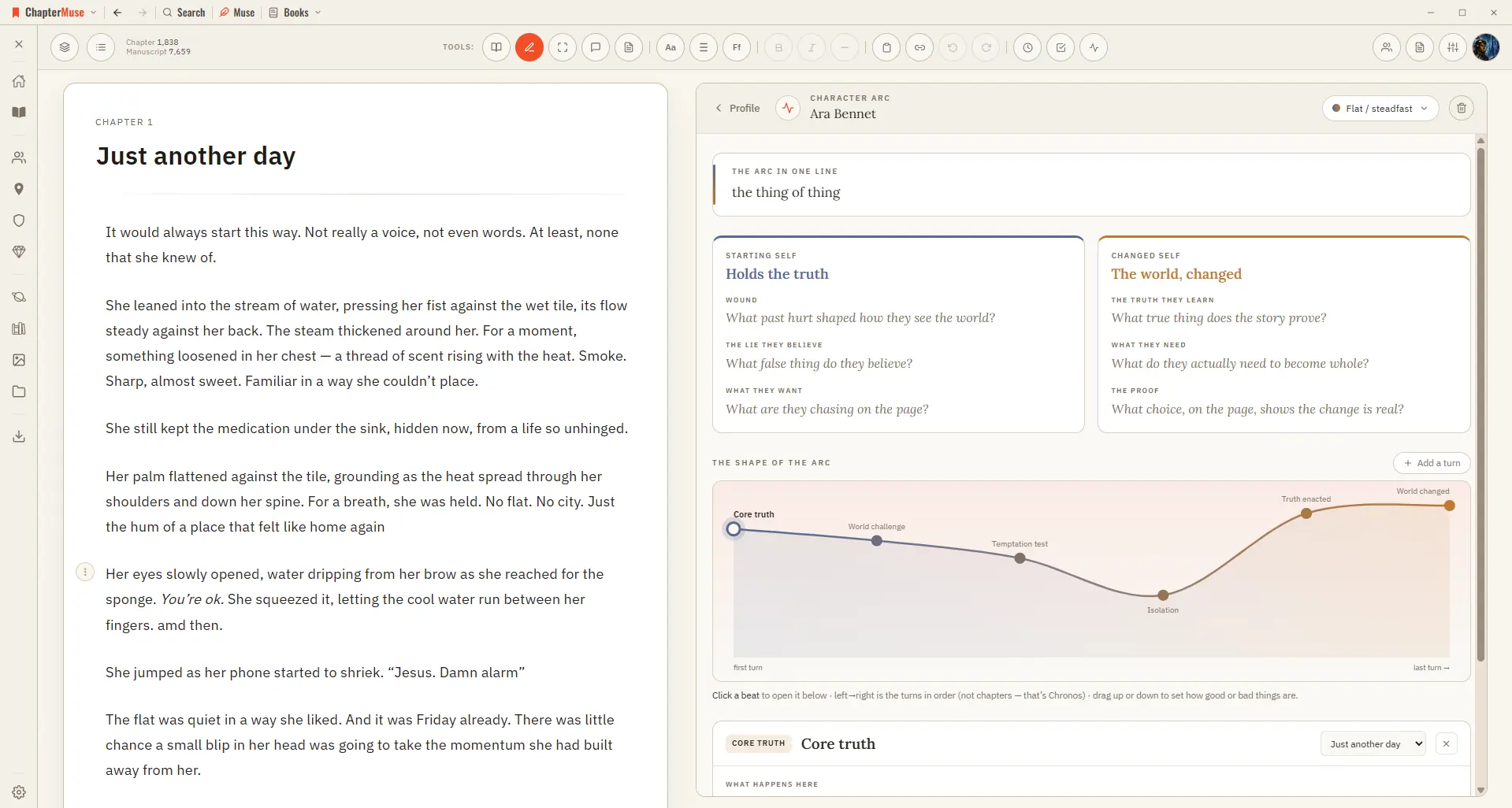
For the whole book, one column in a plot grid does the same job with the other threads beside it: read down and you have the arc; read across and you can see what else was going on in the chapter where nothing changed. Often that's the answer: the arc stalled in chapter thirty-one because thirty-one was busy doing something else, which is a fixable problem rather than a mysterious one.
So when your reader says the ending isn't earned, don't go back and add another paragraph of interiority: that's the instinct, and it never works. Ask which of the six things above happened. Then go and find the page number where the change is visible, and if there isn't one, you now know exactly which scene you are writing this week.
Sources and further reading
- 01K. M. Weiland, Creating Character Arcs (2016): the Lie the Character Believes, the flat arc, and the insistence that the Lie once worked
- 02Lisa Cron, Story Genius (2016): the misbelief and its origin scene: backstory written as a scene, not as a note
- 03John Truby, The Anatomy of Story (2007): desire versus need, the split between psychological and moral need, and cast design as a moral argument
- 04Charles Baxter, Burning Down the House: Essays on Fiction (1997): "Against Epiphanies": the moment of realisation mistaken for the deliverable
- 05E. M. Forster, Aspects of the Novel (1927): flat versus round as an axis of complexity, not of change
- 06Jane Austen, Pride and Prejudice (1813): chapter 36: the lie named precisely, twenty-five chapters before it is proved
- 07Charles Dickens, Great Expectations (1861): chapter 56: proof staged as the exact condition the earlier self could not bear
- 08Oscar Wilde, The Picture of Dorian Gray (1891): chapter 20: a negative arc with the checking instrument built into the premise
Common questions
- What is a character arc?
- A sequence of choices under pressure that changes what a character is willing to do. Not a mood graph and not a backstory: if you can't name three moments where the character does something they could not have done earlier in the book, with a page number for each, what you have is a description of an arc rather than an arc.
- What is the lie a character believes?
- A false conclusion about how the world works, usually formed in a specific past moment: Lisa Cron calls it the misbelief, K. M. Weiland the Lie the Character Believes. The part that gets left out is that it has to have been useful. If believing it has never once made the character's life better, it isn't a belief they hold, it's a flaw you have assigned them, and giving it up will cost nothing.
- What is the difference between a character's want and their need?
- The want is what they are chasing; the need is what would actually make them whole. They aren't opposites: the want is the need misfiled, because the lie has convinced the character that this particular thing will fix what is wrong. The practical test is concreteness: a want you cannot photograph will not generate scenes, so "to belong" has to become the tenancy on a specific flat that a specific person can refuse her.
- Does every character need an arc?
- No. Flat or steadfast protagonists hold a truth and change the world instead of being changed by it, which covers most series detectives and a great deal of fantasy; Lee Child's answer on the subject was "we don't need no stinkin' arcs". Secondary characters generally need a position on the protagonist's lie rather than a journey of their own, when everyone in a novel is transforming, nobody is.
- How do I show a character has changed instead of telling the reader?
- Give them a choice that costs exactly what the lie was protecting. If the lie protected them from being seen, make them be seen; if it protected them from ever needing anyone, make them ask out loud. Then make sure there is an earlier, smaller scene of the same kind in which they took the other option, so the reader has something to measure it against and reaches the conclusion themselves.