Your reader hands the manuscript back and says the pacing is off. You ask where, and they are genuinely trying to help, so they say: around the middle? And the bit at the airport, maybe. You go and look at the bit at the airport. It is four pages long, two people have a row in it, somebody misses a flight. If anything it seems rather eventful. You cut two hundred words, take out three adverbs, and put it back.
That is the standard experience of receiving this note, and the reason it goes nowhere is that pacing is not a property of your manuscript. It is a sensation in your reader, reported after the fact, by somebody under no obligation to know what caused it. Worse, the same sensation is produced by at least four unrelated faults, and two of them get worse if you cut words.
So we need a definition that tells you what to do next. Not "how fast the story moves", which is where every article on this subject stops and which explains nothing, because you can name a dozen fast books that drag and a dozen slow ones you couldn't put down.
Pacing is the rate at which the reader's understanding changes
Here is the working definition. Pace is not events per page. It is new understanding per page: the difference between what the reader knows, fears, wants and suspects at the top of a page and what they know, fear, want and suspect at the bottom of it. When that difference is large, the reader turns the page whether or not anything exploded. When it is near zero, they put the book down on the arm of the chair, and no amount of incident will stop them.
This is why a car chase can be slow. A chase in which the reader learns nothing they didn't know two pages ago (the hero is competent, the villain is close, the streets are wet) has a high event rate and a change rate of zero. It reads as noise. And it is why two people sitting on a bench can be unbearably fast, if every exchange shifts what the reader believes is going to happen to them.
Nothing in your book is fast or slow. It is either changing what the reader knows, or it isn't.
Le Guin puts the same idea at the level of the sentence, in the first chapter of Steering the Craft, and it is worth having in your head before we go any further, because everything below is a consequence of it.
“The chief duty of a narrative sentence is to lead to the next sentence, to keep the story going. Forward movement, pace, and rhythm are words that are going to return often in this book.”
Once you accept that pacing is a rate of change rather than a speed, the note stops being one problem and becomes four, which is progress, because you can only fix one thing at a time. In rough order of how often I see them:
- Wrong resolution. You rendered something at scene length that wanted three sentences of summary, or, less often, summarised something the reader needed to live through.
- No stake in the present tense of the page. The reader cannot name anything they currently want to happen or fear will happen. This is what "too slow" nearly always means.
- An undercooked beat. Something big happened and the reader was moved past it before they could feel it. This is what "too fast" nearly always means, and it is a slowness problem in disguise.
- Monotone. Every scene runs at the same resolution and the same sentence rhythm for eighty pages. Nothing here is individually wrong, which is why this one is so hard to find.
Crowding and leaping is the whole engine
The best thing written on this is a fourteen-page chapter of Le Guin's Steering the Craft called "Crowding and Leaping", and if you read one thing after this article, read that. Her two words are better than the entire vocabulary of pacing advice because they name what you actually do with your hands.
Crowding is packing the prose full: vivid, exact, dense, each detail earning its space, the story kept interconnected with echoes forward and back. It is what Keats meant, she says, by "load every rift with ore". Leaping is what you do between the crowded parts: you jump. And her line about it is the one to write on a card and stick above the desk.
“What you leap over is what you leave out. And what you leave out is infinitely more than what you leave in. There's got to be white space around the word, silence around the voice.”
Pace is the ratio between those two things, and (this is the part people miss) the ratio has to keep changing. A book that crowds continuously is exhausting; a book that leaps continuously is a synopsis. What holds a reader is the alternation, and specifically the fact that the alternation is meaningful: the crowded parts are the parts that matter.
An hour, crowded
Poe's narrator has decided to kill the old man he lives with. He spends a week practising. Watch what happens to time.
And every night, about midnight, I turned the latch of his door and opened it, oh, so gently! And then, when I had made an opening sufficient for my head, I put in a dark lantern, all closed, closed, that no light shone out, and then I thrust in my head. Oh, you would have laughed to see how cunningly I thrust it in! I moved it slowly, very, very slowly, so that I might not disturb the old man's sleep. It took me an hour to place my whole head within the opening so far that I could see him as he lay upon his bed.
Nothing happens. A door opens. That is the whole event, and it takes an hour of story-time and about ninety words of page-time, and the ninety words are almost entirely repetition: closed, closed; slowly, very, very slowly. Poe is not describing the door. He is making you experience an hour. The repetition is the mechanism: each doubled word is a hand not moving, and by the end of the paragraph you are in the room with a man who has all night and no hurry, which is a far more frightening thing than a man with a knife.
Ten years, leapt
Now the opposite, from the middle section of To the Lighthouse. Woolf has spent a hundred and fifty pages on a single afternoon in a summer house. Then she writes a section called "Time Passes" in which a decade goes by, mostly as weather. Three paragraphs of wind and leaves and the sea. And then, closing the chapter, this:
The nights now are full of wind and destruction; the trees plunge and bend and their leaves fly helter skelter until the lawn is plastered with them and they lie packed in gutters and choke rain-pipes and scatter damp paths.
[Mr. Ramsay stumbling along a passage stretched his arms out one dark morning, but, Mrs. Ramsay having died rather suddenly the night before, he stretched his arms out. They remained empty.]
The central character of the first half of the novel dies in a subordinate clause, inside square brackets, off to one side of a paragraph about gutters. Half a page earlier we had eleven words on how a leaf turns in the hollow of a wave.
That is not Woolf being cold. It is the most violent pacing decision in twentieth-century English fiction and it works precisely because of the ratio: the reader has been trained by two hundred pages to expect that anything mattering to Mrs Ramsay will be given air, and then the thing that matters most is thrown away in a bracket. The bracket is the grief. If she had crowded the death (a deathbed, a doctor, the children told one by one) it would have been a sad chapter. Leaping it makes it unbearable.
Scene and summary is the lever you are not pulling
Crowding and leaping has a workmanlike equivalent that every editor uses without saying it aloud, and it is the single biggest lever on pace in a novel. Janet Burroway's definitions are the cleanest: summary "covers a relatively long period of time in a relatively short space on the page"; scene "deals at length with a relatively brief period of time". Her metaphor is better still: scenes are the bricks, summary is the mortar that holds them together.
Most manuscripts with a pacing problem are all brick. Every event in the book (the confrontation, the discovery, the drive to the shops, the mildly awkward breakfast the morning after) is rendered at the same resolution, in real time, with dialogue and weather and gestures. The writer has done this for a very understandable reason: they were told to show, not tell, and they took it as law rather than as a corrective to a specific nineteenth-century habit. So they show everything. And a book in which everything is shown has no gears.
Rendered
Two pages of Marek and his sister at the solicitor's office: the receptionist, the bad coffee, the forms, the solicitor's careful voice, Marek's sister crying in the car park afterwards.
Everything is there. Nothing in it is new to the reader, who worked out three chapters ago that the house would have to be sold.
Leapt
"It took the solicitor forty minutes to tell them what they already knew. Ilona did not cry until the car park."
Two sentences. The reader loses nothing and gains a page and a half of attention to spend on the scene that actually costs somebody something.
Jack Bickham, unromantic about this in a way I find useful, frames it as a rhythm you control directly: dramatised scenes read fast because they are conflict, and the reflective passages between them read slow because they are thought. His verdict after decades of teaching is that inexperienced writers overwhelmingly err towards slow (too much interiority, too much description, scenes that were never scenes) and that most manuscripts called slow are not overwritten sentence by sentence. They are over-rendered.
So the question to take to a suspect chapter is not "how do I make this tighter". It is: does this want to be a scene at all? A scene is what you spend when something changes irreversibly: the thing the scene-level turn exists to identify. Everything else is mortar, and mortar can be three sentences.
The reader feels rhythm in their body before they notice it
Everything above is architecture. But a reader's minute-to-minute sense of pace is made much lower down, in the length and shape of sentences, and this is the level at which "it drags" can be true of a page where the plot is moving perfectly well.
Gary Provost demonstrated it rather than explained it, in a paragraph that has been passed around writing rooms since 1985 because nobody has improved on it:
“This sentence has five words. Here are five more words. Five-word sentences are fine. But several together become monotonous. Listen to what is happening. The writing is getting boring. The sound of it drones. It's like a stuck record. The ear demands some variety. Now listen. I vary the sentence length, and I create music. Music. The writing sings. It has a pleasant rhythm, a lilt, a harmony.”
Length variation is the obvious part and it is not the whole of it. Three other things matter as much:
Where the weight falls. English sentences dump their emphasis at the full stop. A sentence that ends on its most important word lands; a sentence that ends on a trailing prepositional phrase leaks. "She was still holding the letter when he came back into the room" and "When he came back into the room she was still holding the letter" contain identical information and do completely different work, because in the second one the reader's last image is the letter.
Subordination. Clauses hung off other clauses with which, although, while, having are the brake pedal. They ask the reader to hold something open. Strings of short main clauses joined by and, or by nothing at all, are the accelerator. Notice that Poe's crowded paragraph is almost entirely short main clauses: he is slowing story-time down while speeding the sentences up, which is why it reads as tension rather than as description.
White space. Le Guin's "white space around the word" is not a metaphor; it is literally the look of the page. A four-hundred-word paragraph reads as slow before a single word of it has been processed, because the eye has already priced the effort. Breaking it in two costs you nothing and buys a gear change. This is also why dialogue reads fast: it is mostly margin.
You cannot hear any of this silently, which is the honest argument for reading a chapter aloud, or having something read it to you, which is better, because your own voice will unconsciously perform the rhythm you intended rather than the one you wrote. If you would rather see it than hear it, sentence length and variety are among the few craft properties a machine can measure honestly, and a variety score sitting flat across a chapter is a real finding even if the number itself means nothing on its own.
Compression is how you tell the reader what matters
There is a measurement almost nobody takes on their own manuscript, and it is more diagnostic than word count: how much story-time passes per page, chapter by chapter.
Poe gives an hour to a paragraph. Woolf gives a decade to a section and a death to a bracket. Between those two extremes sits every decision you make about proportion, and the reader reads that proportion as emphasis whether or not you meant them to. Renni Browne and Dave King, editors who have seen more manuscripts than either of us will, treat this as a rule of thumb: the space an event gets should be roughly proportional to its importance, and one of the most reliable ways to make a big scene land is to narrate the smaller event before it, so the big one arrives with a change of gear attached.
The corollary is uncomfortable. If you render a breakfast at the same resolution as a betrayal, you have told the reader they weigh the same. Not with a sentence: with a shape, which is much harder to argue with. A manuscript where every chapter covers a similar span of time at a similar magnification is a manuscript with no emphasis at all, and the reader experiences absent emphasis as slowness, because they cannot tell what to lean forward for.
This also explains the commonest failed fix. Told the book is slow, the writer goes through and cuts five per cent from everywhere: a clause here, an adjective there, evenly, fairly, across four hundred pages. The result is a slightly shorter book with exactly the same problem, because the flatness was never in the sentences. You do not create pace by trimming uniformly. You create it by making some parts much smaller so that others can stay big.
"Too fast" means the reader wasn't given time to care
Now the two notes themselves, because both of them are misreported in the same direction.
"It felt rushed" almost never means too much happened. Readers have very high tolerance for event; they will accept a coup, a shipwreck and a wedding in thirty pages. What they will not accept is being moved past a moment before they have had time to feel it. The note is not about the quantity of plot. It is about an emotional beat that was delivered and then abandoned.
The mechanism is simple. A reader converts event into meaning by watching somebody react to it. Take the reaction away and the event stays inert: information, not experience. So a chapter where the brother dies on page four and the funeral is on page six and by page nine we are back on the case reads as fast, but the actual fault is that a death has been given the emotional handling of a change of address. Paradoxically the fix is almost always to slow down and crowd, not to cut event: the reader wanted the same plot, rendered at a resolution that admitted it mattered.
Donald Maass's micro-tension is the tool for the aftermath, and specifically for the aftermath that would otherwise be dull. He defines it as tension that keeps the reader wondering what will happen "not in the story, but in the next few seconds", and it is generated by conflicting feeling, not by conflicting people. A character who is grieving and also, disgracefully, relieved will hold a page for a very long time with nothing happening on it. A character who is simply sad will hold it for two paragraphs.
There is a second, rarer version of the note, worth naming because the fix is the opposite: the reader has not yet been given anything to want. Speed before desire reads as noise. If your opening thirty pages are relentless and readers call them hard to follow rather than exciting, you have a stakes problem wearing a pacing costume.
"Too slow" means nothing is at stake on this page
And the other one. When a reader says a stretch is slow, the instinct is to assume verbosity, and the instinct is nearly always wrong. Ask them where they stopped for the night, and then look at that page and ask a single question: what does the reader currently want to happen, and what are they afraid might happen instead?
If you cannot answer in one sentence, the prose was never the problem. A page with no active want on it is slow at any word count. A page with an urgent one is fast even if it is entirely description, which is why a well-made siege can spend four hundred words on a wall.
The other great, invisible cause of slowness is redundancy of understanding. Not repeated words: repeated knowledge. A scene in which a character tells another character something the reader watched happen in chapter nine has a change rate of zero by definition, no matter how well written it is. So does the paragraph where a viewpoint character reasons their way to a conclusion the reader reached ten pages earlier. So does the third piece of evidence for a thing already proved twice. Go looking for these and you will find, I promise, more of them than you expect, and cutting them speeds a book up in a way that cutting adjectives never does.
Telling the reader something twice is not slow prose. It is a page on which nothing at all happened.
This is also the honest reason so much of a first draft is slow: you were working out what you thought while you wrote it, and the working-out stayed in. It served you. It does not serve the reader, who arrives at the conclusion with you and then has to sit through the reasoning again.
How to find it in your own book
You cannot feel your own pace by rereading, because you already know what happens; the change rate for you is permanently zero. So the diagnosis has to be done with something other than your instincts. This is the order I would go in.
- Get a page number, not an impression. Ask every reader the same question: where did you stop for the night, and where did you skim? Skimming is the only completely honest pacing data that exists. Note that the fault usually sits ten to thirty pages before the place they name: by the time boredom is conscious, it has been building a while.
- Build a change column. One line per chapter, naming what the reader knows or fears at the end that they didn't at the start. Not what happened: what changed for the reader. Then read only that column. Runs of "nothing new" and runs of "same thing again, bigger" are your flat stretches, and they will not be where you thought.
- Add a time column. Elapsed story-time per chapter. Four chapters covering one evening followed by a chapter covering a year is not automatically wrong, but it is always a decision, and if you did not make it deliberately, go and make it now.
- Sort chapters by length and look at the extremes. Your longest chapter should be doing your heaviest work. If it is a travel sequence or a piece of world explanation, you have found a resolution problem without reading a word.
- Read the two worst chapters aloud, at speed. You will hear the monotone, and you will hear yourself skip a line, which tells you the line was already dead.
- Then, and only then, edit sentences. Rhythm work on a chapter that has no business existing is the most expensive way to waste an evening.
Step two does most of the work, and it is the one people skip because it feels like admin rather than writing. It isn't: it is the only view of your book in which a flat stretch is visible rather than merely felt. If the flat stretch sits in the second act (and it usually does, because that is where the opening's promises run out) the diagnosis becomes structural, and that is a different job with a guide of its own.
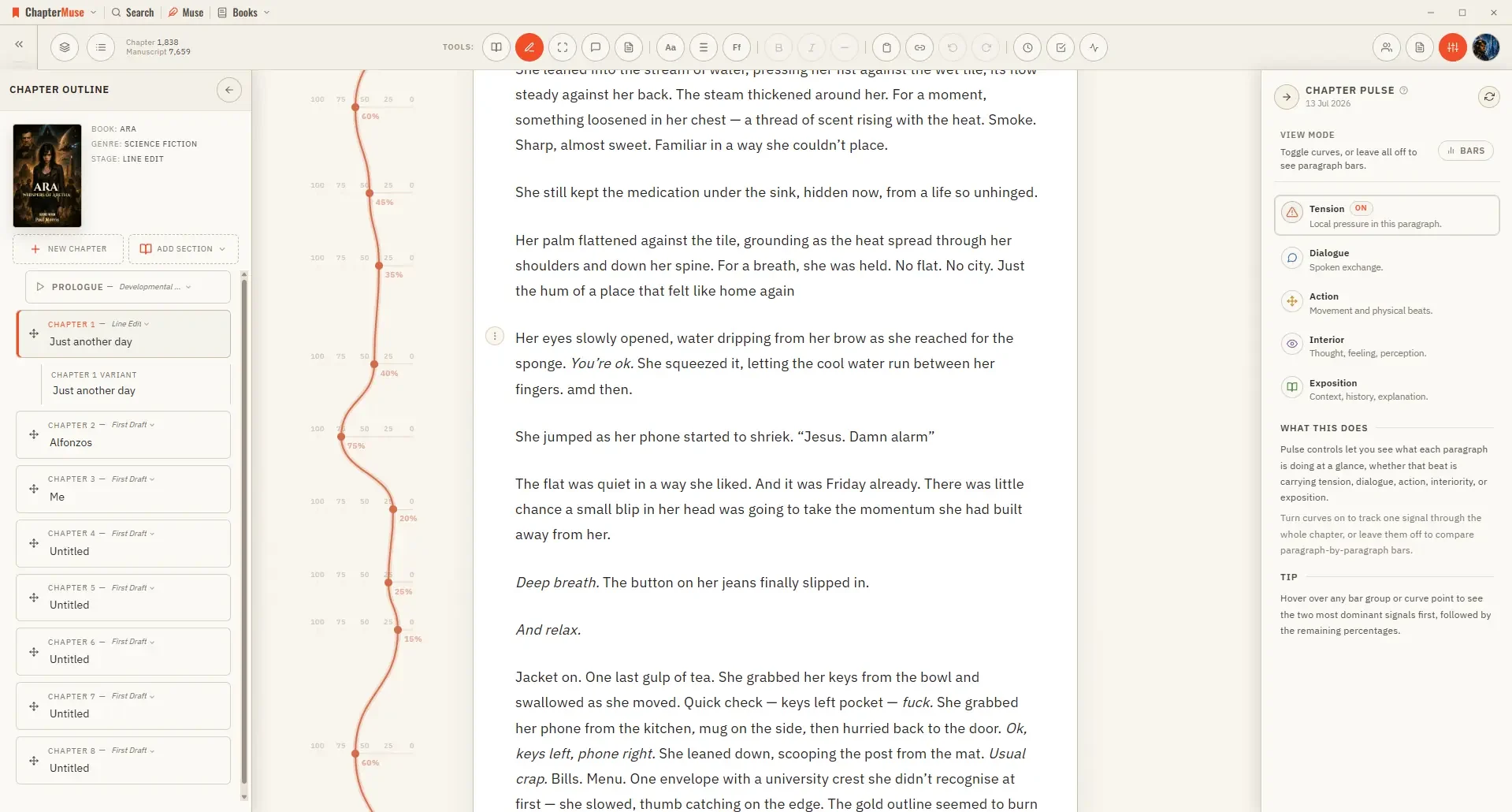
At the level of a single chapter, the same principle can be pushed further. A per-paragraph read of where tension, dialogue, action and interior sit in a chapter (which is exactly what Chapter Pulse draws) is not an oracle and it will not tell you whether a chapter is good. What it will show you, instantly, is a long unbroken run of one colour: forty paragraphs of interior thought, or eleven pages that are dialogue and nothing else. That shape is the monotone, and it is nearly impossible to see from inside the prose.
None of this makes the original note useful. It was never going to be: "the pacing is off" is a reader telling you, accurately, that something in the machinery is wrong, in the only word available for an effect rather than a cause. What you can do is stop acting on it directly. Ask where they stopped. Then find out whether the reader on that page wanted anything, whether they had already been told what you were telling them, and whether the last big moment was given room to hurt.
One of those three will be the answer, and none of the three is fixed by cutting adverbs.
Sources and further reading
- 01Ursula K. Le Guin, Steering the Craft (1998; revised 2015): chapter one on the narrative sentence, and "Crowding and Leaping": the frame this whole article rests on
- 02Edgar Allan Poe, The Tell-Tale Heart (1843): the crowded example: an hour of story-time in ninety words of repetition
- 03Virginia Woolf, To the Lighthouse (1927): the leap: ten years as weather, and a death inside square brackets
- 04Janet Burroway, Writing Fiction: A Guide to Narrative Craft (1982–): summary and scene defined by time-on-the-page; scenes as bricks, summary as mortar
- 05Jack M. Bickham, Scene & Structure (1993): pace as a consequence of how scene and sequel are handled, not of sentence length
- 06Donald Maass, The Fire in Fiction (2009): micro-tension: suspense over the next few seconds, generated by conflicting feeling
- 07Gary Provost, 100 Ways to Improve Your Writing (1985): the sentence-length demonstration nobody has bettered in forty years
- 08Renni Browne and Dave King, Self-Editing for Fiction Writers (1993): proportion: space on the page as the signal of importance, and narrating the beat before a big scene
Common questions
- What does pacing mean in a novel?
- Not speed. Pacing is the rate at which the reader's understanding changes: the gap between what they know, want and fear at the top of a page and at the bottom of it. That is why a chase scene can drag and a conversation on a park bench can be unputdownable: the chase may add no new understanding, and the conversation may change everything.
- How do I fix pacing in my novel?
- First work out which of four faults you have, because they need opposite fixes. Wrong resolution (a scene that wanted to be summary) is fixed by leaping. No stake on the page is fixed by giving someone something to lose. An undercooked beat is fixed by slowing down, not cutting. A monotone is fixed by making some parts much smaller so others can stay big. Trimming words evenly across the whole book fixes none of them.
- Why do readers say my book is too slow?
- Usually because on the page where they stopped, the reader could not name anything they wanted to happen. The second most common cause is redundancy of understanding: a scene where a character is told something the reader already watched, or reasons their way to a conclusion the reader reached ten pages ago. Both have a change rate of zero regardless of how well the prose is written.
- What does it mean when an editor says my book feels rushed?
- Almost never that too much happened. It means an emotional beat was delivered and then abandoned before the reader could feel it: a death given the handling of a change of address. The fix is generally to crowd the aftermath rather than to cut the event, since readers convert event into meaning by watching somebody react to it.
- What is the difference between scene and summary?
- Janet Burroway's definitions are the clearest: summary covers a long period of time in a short space on the page; a scene deals at length with a brief period of time. Scenes are the bricks, summary is the mortar. Most manuscripts with a pacing problem are all brick (everything rendered in real time) which leaves the book without gears.