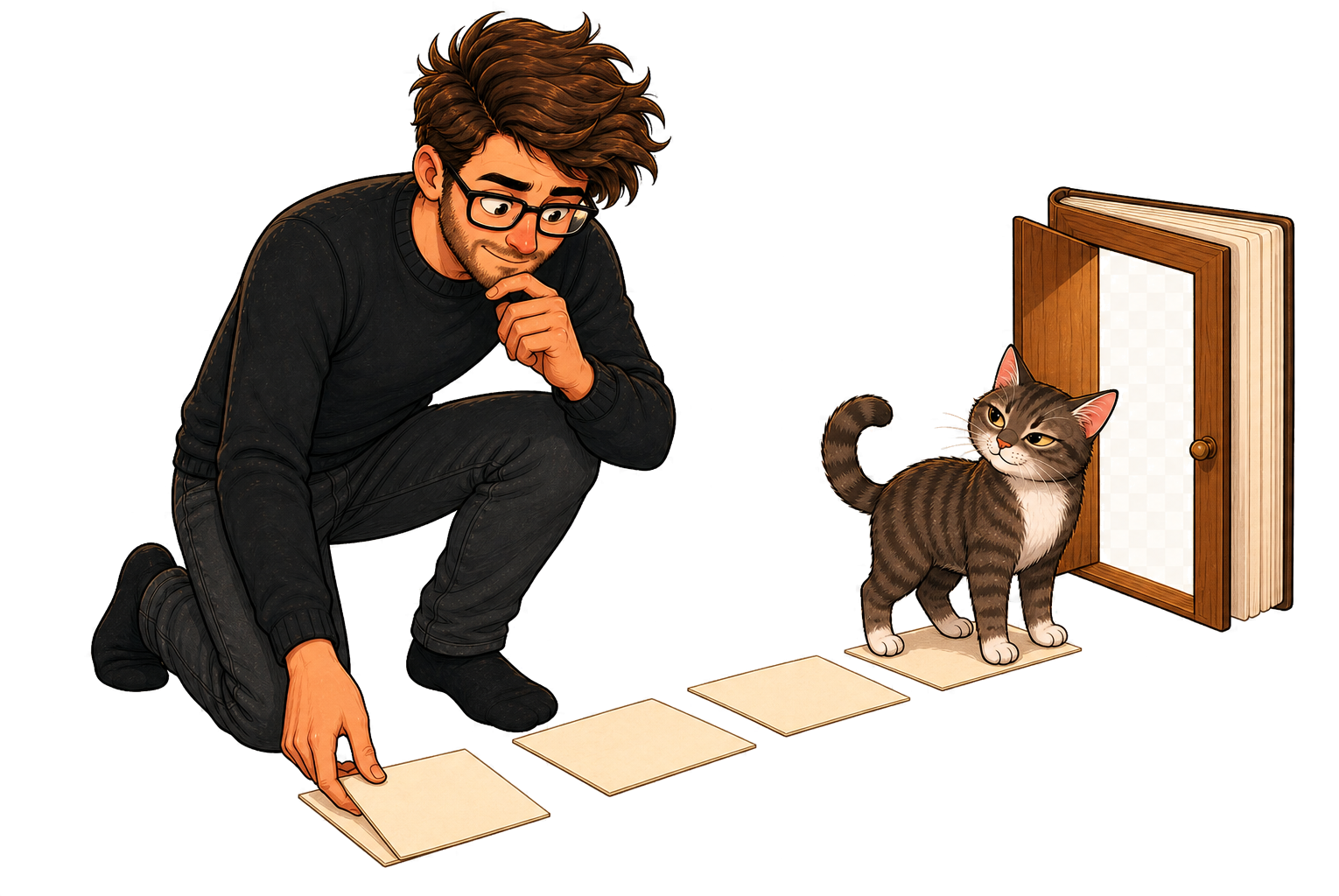
Two people talk in a kitchen for four pages. You know the dialogue is good, because you read it aloud and it sounds like people who have known each other a long time. Your first reader got to the end and said, kindly, that it dragged a little in the middle. You can't argue, because you felt it too: somewhere around the second page, that sensation of a scene idling with the handbrake on.
Every craft book will now say the same three words at you. Goal, conflict, disaster. They aren't wrong. They're also not much help at eleven at night with the draft open, because they describe a scene's skeleton from the outside, and what you actually need is to find the specific sentence in your specific pages where a thing should have happened and didn't.
So let's find one. Not in your draft: in a book you have probably already read, where the turn is made so cleanly you can put a finger on the exact clause where it happens.
A scene turns when something stops being possible
The most useful definition of a scene I know is Robert McKee's, and it is worth the slightly clinical phrasing, because every word in it is load-bearing.
“A SCENE is an action through conflict in more or less continuous time and space that turns the value-charged condition of a character's life on at least one value with a degree of perceptible significance.”
Strip the vocabulary out and it says: something that mattered was in one state at the top of the scene and is in a different state at the bottom. McKee's own diagnostic is two questions: what is at stake here, and where is that thing by the last line. His verdict on the scenes that fail the test is blunt. They have activity but no change; they are, in his word, a nonevent.
I want to push it one step further, because "something changed" is still slippery enough that you can talk yourself into believing your kitchen scene qualifies. Here is the harder version, and it's the one I actually use:
A turn is not an event. It is a door closing behind the characters while they are still talking.
Something was available at the start of the scene (a course of action, a belief, a friendship, an excuse, an escape route, a version of yourself you could still plausibly claim) and by the end it is gone. Not made harder. Gone. Whatever happens on the next page has to be chosen from a smaller set of options than the ones the characters had when they walked in.
That framing has one enormous practical advantage over goal-conflict-disaster: it is falsifiable. You can hold your scene up against it and get a straight answer. "Did my scene have conflict?" invites a hopeful yes. "Name the thing that was possible on page one of this scene and is impossible on page four" does not. Either you can name it in a short sentence or you can't, and if you can't, you have found your problem before you've spent another evening polishing the dialogue.
Austen turns a proposal on eight words
Chapter thirty-four of Pride and Prejudice. Darcy has arrived, unannounced, and proposed to Elizabeth in the most insulting terms a man has ever managed while sincerely believing he is paying a compliment. She refuses. He asks, stiffly, why he has been rejected with so little civility. And then this.
"You are mistaken, Mr. Darcy, if you suppose that the mode of your declaration affected me in any other way, than as it spared me the concern which I might have felt in refusing you, had you behaved in a more gentleman-like manner."
She saw him start at this, but he said nothing, and she continued:
"You could not have made me the offer of your hand in any possible way that would have tempted me to accept it."
Notice what does not turn the scene. The refusal doesn't. A refusal is a piece of information, and Darcy could have walked out of that room with his opinion of himself entirely intact: bruised, certainly, but intact, because a woman declining an offer she was foolish not to take says nothing about the man who made it. He came in believing his conduct had been that of a gentleman throughout, and a plain no leaves that belief exactly where it was.
The turn is "had you behaved in a more gentleman-like manner". Eight words, tucked into a subordinate clause at the end of a long sentence, doing something the whole rest of the novel is downstream of. Because that is a charge Darcy cannot dismiss and cannot answer, and (this is the part that makes Austen Austen) she does not tell us he cannot answer it. She stages it.
"She saw him start at this, but he said nothing." Seven words of body language and one of silence. Charles Baxter calls this the real work of scene-writing:
“It shows us how the characters are behaving, and it shows us what they cannot say through the manner in which they say what they can say.”
Darcy starts because it lands. And once it has landed, the thing that was available to him at the top of the scene (going on believing himself a fundamentally well-behaved man who has been unlucky in his associations) is not available any more. He will spend the night writing a letter about it. He will spend a year and a half becoming a person to whom the charge doesn't apply. Every subsequent thing he does in the book is chosen from the narrower set of options that clause left him.
Both sides of a good turn move
Elizabeth's terms change too, and in the opposite direction, which is what stops the scene reading as a woman scoring points off a man. She has said the unsayable out loud. Before this she could dislike Darcy privately, comfortably, at no cost, with the smug ease of someone whose contempt has never had to be defended in public. Now it has been spoken, in full, to his face, with reasons, and reasons can be checked. Twelve hours later a letter arrives that checks them, and she cannot go back to the cheap version of her own dislike either.
That is a useful thing to look for in your own scenes. When only one person leaves the room changed, you have usually written an ambush rather than a scene. When both do, and in different directions, you get the thing readers describe as a scene having weight.
Agreement is what's killing your kitchen scene
Here's the uncomfortable diagnosis, and it is nearly always the right one for a scene the writer likes and the reader doesn't: everybody in the room wants the same thing, and says so.
The information moves. Facts get established, backstory gets delivered, a plan gets made. It's all perfectly competent. But no line costs the person saying it anything, because nobody in the scene is at risk of being contradicted, disappointed, exposed or refused. Two allies agreeing at length is not a scene. It's a briefing with dialogue tags.
A briefing
"We should talk to Marguerite before the hearing."
"Agreed. She'll know what the committee is likely to ask."
Nothing said here can be refused, so nothing said here costs anything. The scene ends when the writer runs out of exposition.
A scene
"We should talk to Marguerite before the hearing."
"You should. I'm not going near her."
Now the request can fail, and one of them has admitted something they'd have preferred to keep. The scene ends when a door shuts.
The other common version is the mouthpiece scene, where one character explains the situation to another character who mostly asks clarifying questions. You can spot it by the dialogue: if a line could be cut and pasted into a different chapter without anyone noticing, it isn't a line, it's a paragraph of narration wearing quotation marks. Real dialogue is positional. It belongs to a person who wants something in this room, at this minute, from the person opposite.
None of this means the scene has to be an argument. It means somebody in it has to be able to lose something. Withholding counts. Lying counts. Being kind when you had planned to be cruel counts. What doesn't count is two people cooperating pleasantly towards an outcome neither of them is going to be denied.
If the beats can be shuffled, they were never causal
Once you suspect a scene is flat, you need a test that doesn't rely on your judgement, because your judgement is compromised: you wrote the thing and you know what it's supposed to mean. The shuffle test is the one I'd give you.
It rests on E. M. Forster's old distinction. "The king died and then the queen died" is a story. "The king died and then the queen died of grief" is a plot: the same events in the same order, but with the emphasis fallen on causality. Forster's point was about novels; it works just as well on the four pages in front of you, because a scene has exactly the same failure mode. Beats that merely follow one another in time will read as a list. Beats that cause one another read as a scene.
- Write out the scene's beats, one short line each: not what is said, but what happens. "She asks him to come to the hearing." "He refuses." "She mentions the money." Six to ten lines for a normal scene. If you can't get it under twelve, that's already a finding.
- Now reorder them. Put beat five before beat two. Swap the last two. Move the middle to the front.
- Read the new order and ask, honestly, what breaks.
- If nothing breaks (if the scene simply plays in a different sequence and still makes sense) your beats are chronological, not causal. They are things that happened next to each other, not things that happened because of each other.
- If it collapses, if beat five is nonsense before beat two because beat two is what made it possible, you have a spine. Now go and find the beat after which the fewest futures remain. That's your turn. If there isn't one, the scene's job is being done by information alone, and it probably wants to be half a page.
There's a quicker version of the same instinct that gets passed around film schools, credited to Trey Parker and Matt Stone: if the word between your beats is "and then", you're in trouble; it should be "but" or "therefore". Same test, smaller. "He goes to the hearing and then she calls" is a list. "He goes to the hearing but she has already spoken to the committee, therefore he has to lie" is a scene.
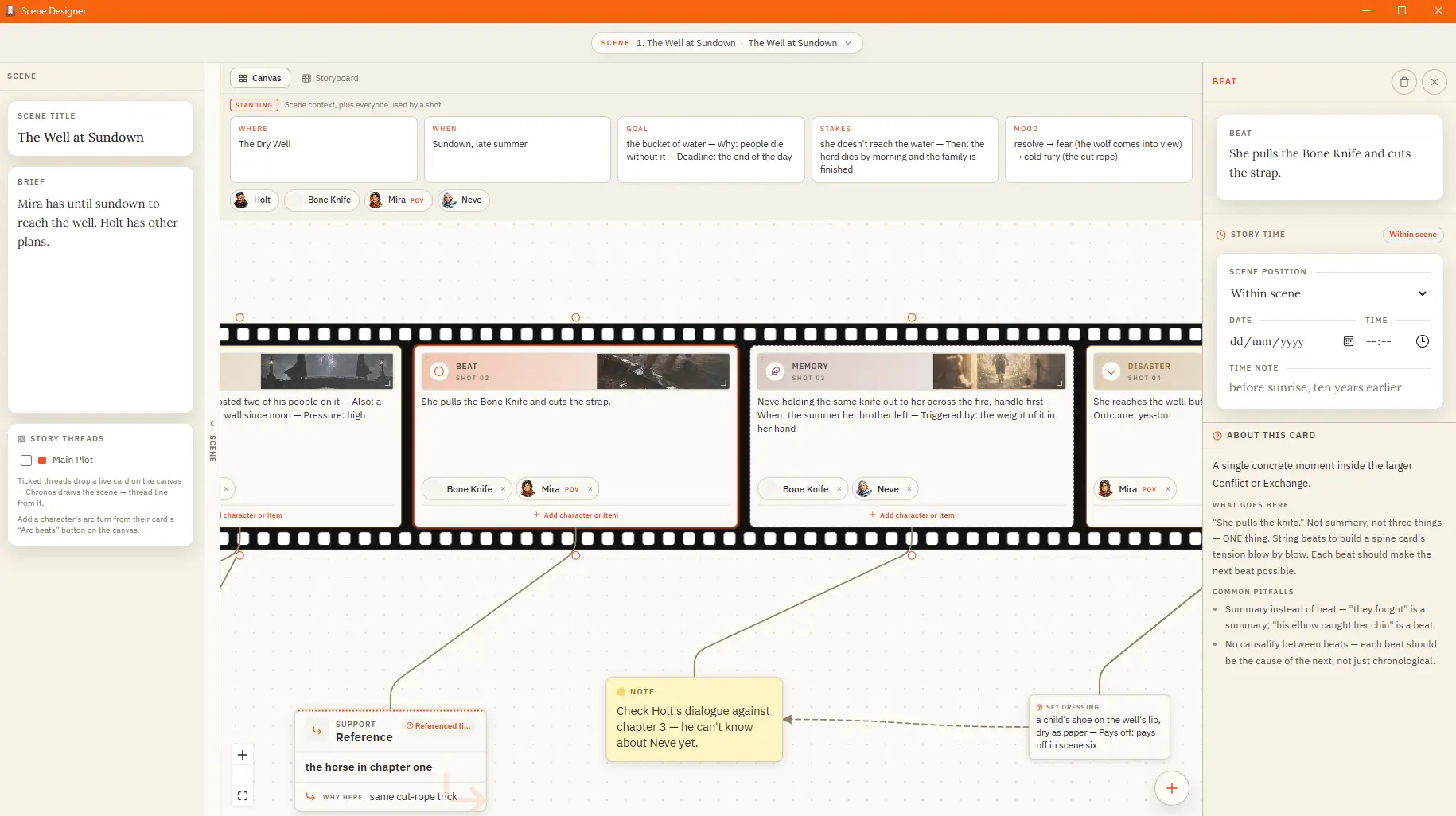
This is easier to do with the beats outside your head, which is the whole reason people write scenes on index cards, sticky notes, or the back of envelopes, and the thing a scene canvas is actually for. Not decoration. Seeing whether the beats hand off to each other, which is nearly impossible to judge while you're inside the prose admiring your own dialogue.
The beat after the turn is a rhythm, not a slot
Dwight V. Swain's Techniques of the Selling Writer (1965) is where most of the modern advice on this comes from, usually second- or third-hand. His scene is goal, conflict, disaster. His sequel (the connective tissue between scenes) is reaction, dilemma, decision: the character absorbs what just happened, finds that their options are bad, and picks one, which becomes the goal of the next scene.
It is a genuinely good model and it has been mangled into a template. The mangled version produces books where every dramatic scene is followed by a dutiful paragraph in which the point-of-view character explains their feelings to themselves and then announces a plan. You've read those paragraphs. They're the ones your eye slides off.
What the aftermath beat is actually for is proof of cost. A turn that nobody pays for didn't happen. If Elizabeth walked out of that room and straight into the next plot event, the reader would file the proposal as a scene about a rude man being told off. Instead Austen gives her a sleepless night and a letter she reads until she has it by heart, and by the time that's over the reader has been made to feel exactly how much the scene took from her. The aftermath is not there to recap. It's there so the change registers as expensive.
Swain's disaster is also where the most portable piece of scene advice in modern craft teaching comes from: the shape of the failure. A flat no. A yes-but: they get the thing and it brings a complication they can't afford. A no-and-furthermore: they fail and the ground gives way underneath. Those three are worth memorising, because they're the quickest way to convert a scene that stops into a scene that turns. Brandon Sanderson teaches the same mechanism as try-fail cycles, at the scale of a whole plot rather than a single scene, and his lecture on it is the clearest hour on the subject that's free to watch.
Which is why the aftermath is often easier to audit than to draft. When you've got a whole manuscript and you're going back through it with a revision pass rather than a blank page, unpaid turns are visible in a way they never are while you're writing forwards: a chapter ends on a revelation and the next chapter behaves as though it didn't happen.
Quiet scenes turn too: they just turn smaller things
The obvious objection to all of this is that most novels are not made of confrontations, and thank God. So here is the end of The Age of Innocence. Newland Archer is in Paris. He has spent thirty years not going to Ellen Olenska. He is now, finally, free to. He has come as far as a bench outside her building, and he sits there while his son goes up without him.
At length a light shone through the windows, and a moment later a manservant came out on the balcony, drew up the awnings, and closed the shutters.
At that, as if it had been the signal he waited for, Newland Archer got up slowly and walked back alone to his hotel.
Nobody speaks. Nobody refuses anybody. The only physical event is a servant closing a shutter, and the servant is not a character. And yet everything the whole novel has been holding open closes in those two sentences: after this, Archer will not see her, and the reader understands that he never will. "As if it had been the signal he waited for" is Wharton telling you, very quietly, that he was looking for a reason not to go up, which means the possibility that dies here isn't really the meeting. It's the version of Archer who would have gone.
That's the shape of a quiet turn. Nothing is contested; something is settled. And it's worth saying that a scene can also turn in the reader rather than in the character: a line of dialogue whose second meaning only you and the reader catch, after which the reader can no longer hope for something they were hoping for two pages ago. The character walks out unchanged. The book doesn't.
So the test survives contact with quiet material, as long as you're willing to accept small answers. What became impossible? He can't tell himself he'd have gone if he'd only been free. She can't pretend she didn't notice. They can't have this conversation again. Once you've got the habit, keeping one line per scene naming what changed (which is all the summary field in an outliner is really good for) will show you the flat stretch of your book faster than any amount of rereading, because the flat stretch is where you find yourself writing "they discuss the plan" four times.
Constant conflict is its own kind of flatness
Now the correction to the correction, because writers who take the turn seriously tend to overshoot in a predictable way: they go back through the draft levying an argument tax. Every scene acquires a spat. The mild aunt develops an edge. Two characters who have no reason to disagree are made to disagree so the chapter has some friction in it. What comes out is a book in which everyone is snapping at everyone else and the reader (this is the cruel part) stops noticing any of it.
A book where everything is urgent is a book where nothing is.
Le Guin was rude about this, and she was right to be.
“Conflict is one kind of behavior. There are others, equally important in any human life, such as relating, finding, losing, bearing, discovering, parting, changing.”
She's not saying scenes shouldn't turn. She's saying the turn does not have to be produced by two people fighting, and that a craft culture which only has one tool will reach for it whether or not it fits. A scene can turn on someone finding something. On someone bearing something they had previously refused to bear. On a parting neither party contests. Wharton's shutter is a turn made entirely out of losing: nobody in the scene opposes anybody.
Jane Alison pushes the argument further in Meander, Spiral, Explode (2019), which is worth reading precisely because it will annoy you: she asks why the rising-tension arc, borrowed from Greek tragedy and, she notes drily, a bit masculo-sexual in shape, became the only permitted design for a novel, and offers spirals, cells, waves and meanders instead. You don't have to be converted to get the use out of it. It's a reminder that the arc is a tool with a history, not a law of physics, and that a book can hold a reader by pattern and accumulation as well as by escalation.
That rhythm is a book-level property and it is almost impossible to feel from inside a chapter, which is the honest argument for looking at your novel laid out along its own timeline at some point. Not to plan it into submission. To see where the pressure actually sits, and to notice that you have put four of your biggest turns in a row in chapters nine to twelve and then nothing for eighty pages.
What to do with the kitchen scene
Back to your four pages. Don't rewrite the dialogue: the dialogue was never the problem, which is why polishing it hasn't worked. Do the three things in order.
Reduce it to beats and shuffle them. If nothing breaks, you've confirmed the diagnosis rather than guessing at it. Then write the sentence: at the start of this scene, X was still possible. If you can't finish it, decide what X should be, and the most reliable place to find X is not in the plot but in the thing one of these two people would rather the other didn't say. Then locate the moment the other one says it, and make sure you've staged the reaction rather than reported it. Austen gave hers seven words. You will probably need more, but not many more.
And when the scene turns, resist the urge to explain that it has. The reader who has just watched a door close does not need to be told the door is closed. They need the next scene to be visibly harder than it would have been before.
Sources and further reading
- 01Robert McKee, Story (1997): the scene as a turn in a value-charged condition, and the "nonevent" verdict on scenes that don't
- 02Jane Austen, Pride and Prejudice (1813): the worked example: chapter 34, the first proposal
- 03Edith Wharton, The Age of Innocence (1920): the quiet turn: a closed shutter as the end of a possibility
- 04E. M. Forster, Aspects of the Novel (1927): story versus plot, and the causality distinction the shuffle test rests on
- 05Charles Baxter, The Art of Subtext: Beyond Plot (2007): staging: how characters' behaviour shows what they cannot say
- 06Dwight V. Swain, Techniques of the Selling Writer (1965): scene and sequel; goal-conflict-disaster and reaction-dilemma-decision
- 07Ursula K. Le Guin, Steering the Craft (1998): the case against treating conflict as the only engine of change
- 08Jane Alison, Meander, Spiral, Explode: Design and Pattern in Narrative (2019): the arc as one inherited pattern among many, not a law
Common questions
- How do I know if my scene has a turn?
- Finish this sentence about it: "At the start of this scene, X was still possible; by the end it isn't." If you can name X in a short clause, you have a turn. If you find yourself writing something vague like "the tension increased", you probably have an exchange of information instead.
- Why does my scene drag when the dialogue is good?
- Usually because everyone in the room wants the same thing and says so. Good dialogue between allies who are in no danger of refusing each other is a briefing with quotation marks. Give one character a want the other's request threatens, and the same lines start costing something.
- Does every scene need conflict?
- No: every scene needs change, which is not the same thing. Le Guin's list of other behaviours is a useful corrective: relating, finding, losing, bearing, discovering, parting. A scene can turn on someone accepting a loss without anyone opposing anyone. What a scene can't do is end with the same options open that it started with.
- How long should a scene be?
- As long as it takes to reach its turn, plus whatever aftermath is needed to show the turn cost something. That's why the length question is nearly always a structure question in disguise: scenes that feel too long are usually scenes that turn early and then keep going, or scenes that never turn at all and are padding towards a stop.
- What is scene and sequel, and do I have to use it?
- It's Dwight Swain's 1965 model: a scene (goal, conflict, disaster) followed by a sequel (reaction, dilemma, decision) that produces the next goal. It describes a real rhythm, but treating it as a template produces a paragraph after every scene where the viewpoint character narrates their feelings and announces a plan. Keep the principle (a turn has to be paid for somewhere) and let the payment fall where it fits.